Tuesday, 30 November 2010

Sample Economics IA (IB)

Just a sample Economics IA to give you a feel of what it entails.


An Economics IA typically is focused on one of the 5 areas of the syllabus: Introduction in Economics, Microeconomics, Macroeconomics, International Economics or Development Economics. They require around 650-750 words in length (including diagrams, labels and footnotes).

This IA is on Microeconomics, 747 words long, and is a commentary of the original article, UK house prices rise by 1.6% in August - the largest increase since December 2006, from the DailyMail.co.uk 27/08/09.

The article:


Daily Mail

UK house prices rise by 1.6% in August - the largest increase since December 2006

By Daily Mail Reporter
Last updated at 4:24 PM on 27th August 2009

The average cost of a home in the UK jumped by 1.6 per cent during August

House prices rose for the fourth month in a row during August as the market continued to be boosted by a shortage of homes for sale, figures showed today.

The average cost of a home in the UK jumped by 1.6 per cent during the month, the biggest increase since December 2006, according to Nationwide Building Society.

The annual rate at which prices are falling also continued to ease during August, narrowing to just 2.7 per cent, down from 6.2 per cent in July.

The group said prices were now 3.2 per cent higher than at the beginning of 2009 at an average of £160,224, although it added that they were still 14.4 per cent below their peak in October 2007.

Martin Gahbauer, Nationwide's chief economist, said: 'The exceptionally low level of interest rates offers some explanation for why house prices have not repeated the very sharp falls of 2008.'

He said low interest rates had fed through into lower mortgage repayments for existing homeowners, making it easier for people who lost their jobs to continue to afford their home loan.

As a result fewer people have been forced to sell their home as is normally the case during a recession, and this has contributed to shifting the balance of supply and demand in favour of sellers during 2009.

Low interest rates have also helped make property more affordable for first-time buyers, boosting demand, despite the ongoing problems in the mortgage market.

But Mr Gahbauer warned that when interest rates did start to rise again it could make the recovery in the housing market 'bumpier' than might be expected following the recent run of price rises.

The latest figures on the property market come just days after the British Bankers' Association said the number of mortgages approved for house purchase had risen to a 17-month high during July.

The Council of Mortgage Lenders also reported a 26 per cent rise in mortgage lending in July to its highest level for nine months, as buyers continued to return to the market.

But despite the recent pick up in housing transactions, economists have warned that the number of homes changing hands still remains well down on normal levels.

The ongoing problems in the mortgage market are also continuing to limit the number of people getting on to the housing ladder, despite some recent signs that lenders are beginning to loosen their lending criteria.

As a result, it is thought any recovery in the housing market is likely to be gradual, with some commentators warning that further price falls cannot be ruled out.

The commentary:


The recent global economic recession has generated many problems worldwide, such as increased unemployment, lack of consumer confidence and reductions in salaries and wages. In the United Kingdom, housing prices also plummeted, but during August the average cost for a home rose by 1.6%. This is, according to the article, mainly because of low interest rates and shortage of supply.

Diagram 1: UK Housing Market (Demand Shift)

Low interest rates, the amount borrowers pay to lenders for the usage of the borrowed money, would result in a shift in demand, the ability and willingness to consume a commodity, to the left (Figure 1, D to D1). This is because consumers are encouraged to borrow more, which would lead to increased spending. Consequently, the equilibrium would move from A to B, resulting in an increase in price (P to P1).Diagram 2: UK Housing Market (Supply Shift)

Furthermore, low interest rates would lead to lower mortgage repayments, hence allowing homeowners, usually predicted to sell their homes during a recession, to refrain from doing so. There would be an inwards shift in supply of homes (Figure 2, S to S1), the ability and willingness to provide a commodity, as fewer owners choose to sell their houses, changing the equilibrium from B to C; the price would increase from P1 to P2. Overall, the change in price (P to P2) would amount to 1.6%.

As mentioned in the article, it was forecasted that when there is a rise in interest rates in the future, the housing market may experience some falls in average price. This is because as interest rates increase, there is a higher tendency to save than spend. Thus, the demand curve shifts inwards (Figure 3, D to D1). Also, homeowners may prefer to sell their houses because of higher mortgages, shifting the supply curve outwards (S to S1). On the whole, the equilibrium would have changed from A to B, with prices falling from P to P1.
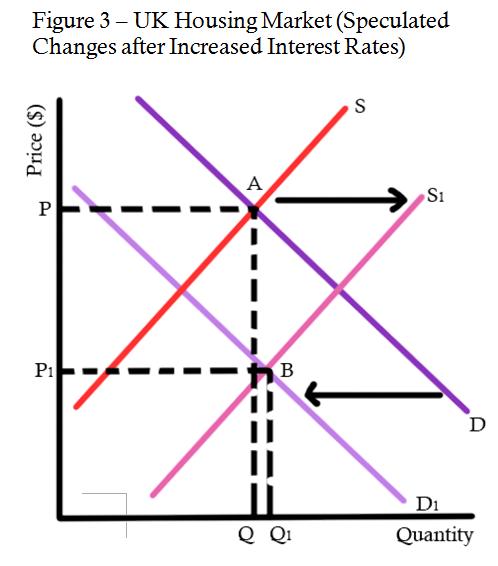
Diagram 3: UK Housing Market (Speculated Changes after Increased Interest Rates)A future increase in interest rates may affect different stakeholders in various ways; demand and supply changes may not follow what is depicted in Figure 3. Those who have high mortgage repayments may sell their homes and seek to find smaller and cheaper housing. Consequently, demand for small homes may increase, whilst demand for larger homes may decrease.

The article presents the view that in the future, there may be further price falls. This is supported by the anticipation of higher interest rates. Also, because consumer confidence is at a low due to the global economic recession, once supply catches up with demand, ceteris paribus, it may be assumed that prices will not rise any further. Hence, some economists would argue that it is most probable that prices would then fall. In addition, the increase of value added tax in January back to the previous rate of 17.5% would result in using income to compensate for the higher prices. Thus, fewer consumers would be able and willing to buy new homes and demand would drop, leading to a fall in housing prices.

However, other factors that affect demand and supply must be considered before that conclusion is made. For example in the USA, tax credit is available for homebuyers; this would increase disposable income, thus increasing demand. If this is also made available in the UK, the prices of houses may not necessarily fall. Also, because there is speculation that prices may rise, there may continue to be a shortage in supply as homeowners wait to take advantage of higher prices when they sell. Demand would also be enhanced by speculation as consumers are more willing to buy when prices are considered low, than in the future when prices may be higher. Some may also consider buying a house as an investment, because prices are predicted to rise. Thus, if these scenarios occur, price falls may not occur.

The article suggests the reasons why UK house prices rose by 1.6% and then speculates, with satisfactory reasons, why prices may fall in the future. In conclusion, the article is accurate in its justification, but does not consider the full array of alternative reasons which may affect the prices of homes.


Economic Development - Notes


Factors that determine the level of economic development:


  1. Quality & quantity of Factors of Production

    1. Capital

    2. Entrepreneurship – Singapore devoid of many natural resources but became a logistics hub

    3. Land – Malaysian rubber trees; Singapore’s natural harbour

    4. Labour – China (emerged into the global economy because of its huge supply of cheap labour that developed into a manufacturing hub)

    5. Government decisions & governance

      1. Corruption – hinders economic activity and growth

      2. Gangs & unrest – decreases economic activity (e.g. Nigeria gangs in Lohas create a protection racket under the pretence of ‘labour unions’ to extort money from bike-taxis, roadside traders…)

      3. Not clearly defined property rights & legislation


- (a.), (b.) and (c.) create allocative inefficiency which is very bad for developing countries as it disrupts the market, decreases economic activity and creates deadweight loss. [Graph]

  1. Infrastructure

  2. Strength of institution

    1. Legal system; Established property rights – greater incentive to set up businesses

    2. Politics (e.g. emerging economies: India’s democratic (short-term policies) vs China’s communist party (increased political stability; allows more time for policies to be seen through and long-term aims to be made))

    3. Natural factors


Sources of economic development:


  • Land quality


- Better planning for land use; fertilization/ irrigation of the area for primary industries

  • Land quantity


- Land reclamation (Singapore); build upwards (Hong Kong)

  • Resources


- E.g. Natural harbor – Singapore; Oil discovery – Dubai, Brazil; Gold deposits – South Africa

  1. Human factors


  • Quantity of human capital


- Baby boom; Immigration

  • Quality of human capital


- Education/ training; health awareness/ promotion; attract skilled migrants

  1. Physical capital & technology


  • Build more infrastructure (e.g. schools, hospitals, roads, housing)

  • Invest more in capital such as machinery, factories etc.

  • Promote saving & investment (e.g. by offering government assistance; loans; grants; subsidies; lowering interest rates)


Capital widening: More people have access to capital – Ratio of capital: per worker doesn’t change.

Capital deepening: Each worker has access to more capital.

  1. Institutional factors


  • Adequate banking system


- Money stays in the country, which allows banks to provide loans to firms and start-up companies, which drives investment (unlike Nigeria where all money earned is sent abroad to safeguard its value)

  • Structure of legal system with established property rights


- Encourages entrepreneurship and businesses to start-up

  • Reliable infrastructure


- Most importantly telecommunications and the internet – needed for most business transactions nowadays

- Transport networks – mobility of labour, raw materials, capital… etc.

  • Education system

  • Political stability


- E.g. China (stable, one party rule – allows the government to make long-term goals and plans for sustainable development of the country )vs India (democratic leadership – where politicians focus more on getting re-elected and tend to implement short-term policies)

Thursday, 18 November 2010

Essential checklist for TOK essays

Not that you can't just read the Marking Criteria and get an A; but for those who are finding it hard to mold a top-scoring essay or as a timely reminder to tick the boxes once you're finished:


  1. [Criterion A] Have you identified the knowledge issues implied in the title?

  2. Have you used a variety of Ways of Knowing and Areas of Knowledge?

  3. Have you tried to link on WoK and AoK? Take 2 examples of each.

  4. Stay on topic, address the question posed.

  5. [Criterion B] Have you drawn on your personal experience? Have you used examples from your own life? A personal voice is very important in TOK essays. Need to be able to identify knowledge issues arisen from your surrounding IB studies. There’s nothing wrong with looking at staid and often-used examples as they can be the best to demonstrate what you are trying to convey. But there needs to be balance with personal examples. Try not to make up examples as they will sound fake. Don’t use trivial examples.

  6. Have you made reference to at least two perspectives? Perspectives from different areas of knowledge, different ways of knowing... Philosophical perspectives, cultural perspectives, societal perspectives.

  7. [Criterion C] Have you provided evidence for your claims? Back it up with examples/ research… Where did you get your ideas from? Show that your arguments have a basis.

  8. Have you examined counterclaims? Think of your essay as a dialogue. Be very aware of how someone who views this differently would attack your argument. (Eg. Sense perception – illusions, phantom pains; how people who don’t have senses experience the world differently to us, they have helped us survive for so long)

  9. [Criterion D] Generally like any essay – intro, body, conclusion, claims, counterclaims – make it clear how you are progressing within the essay.


10.  Have you referenced your examples according to an established format?

11.  Bibliography is consistent (Harvard style, MLA)


Hope this helps!

Friday, 12 November 2010

Guide to UCAS Personal Statement

For a university application to the UK, this is seen by many as the most important part of the application form and as such should be taken very seriously. It could make the difference between getting a place at university of your choice or not.

General Know-How


  • It’s recommended that you prepare your personal statement offline using Word.

  • If you enter your personal statement directly into ‘Apply’ you must save as you go along as it ‘times out’ after 60 minutes of inactivity

  • You can enter up to 4,000 characters, including spaces (up to 47 lines of text)

  • When you save the text, the system will automatically tell you how many characters you have left.

  • Only write things that you are prepared to talk about at an interview - less of a problem for overseas applicants (except for Oxbridge and Medicine), but you should always aim to write about something you actually know. Minimize making up achievements and books you have read as ignorance is easy to come through.

  • Don't repeat material already on the application form. Similarly, show your personal statement to the teacher writing your reference regularly so that there is minimal overlap.

  • You need to sell yourself. Admissions tutors are looking for well-rounded individuals, people with a real interest and motivation in the course they are applying for.

  • Once you have completed your statement, show it to someone who knows you well and let a teacher and/or graduate mentor see it too.


The structure of your personal statement

It’s a good idea to think about your personal statement in terms of the following sections:

  • What you want to study at university and why - Why do you enjoy the subject? Which parts of the subject are of particular interest to you and why? Which parts of the subject would you like to study at university and why? (You have a choice of modules on most courses). Where did your interest in this subject come from? How has any relevant work experience helped you to decide on a particular subject? Where you hope a degree in this subject will lead? What particular subject related skills do you have?


  • How your A levels relate to your chosen degree - How are the subjects you are currently studying fit into your chosen course?  Is there any aspect of the course that you have a particular interest in? (Did you enjoy doing a particular piece of course work or project?) Do you have a part-time job, or have been involved in any charity or community work? Have you helped with school events or open days? (Experiences that show you are a reliable and responsible person) Have you gained any awards or been on any relevant events, for example, Duke of Edinburgh, Summer School or Young Enterprise?


  • Experiences that show you are a reliable and responsible person

  • Write about your career aims - This applies if you have a particular career aim (e.g. nursing, teaching, law...). Why do you want to become a _______? What skills and qualities do you have which will make you suitable for your chosen career?


  • Your interests and skills - try and show what you learnt and any attributes the activities highlight instead of listing them. For example, you could incorporate attributes and skills universities look for like:


Practical

 
Problem solvingCaringEnthusiastic
Teamwork

 
Good communicatorUsing own initiativeWork under pressure
Self motivated

 
Working to deadlinesOrganisationLeadership
Self-expression

 
Computer literateArtistic/ creativeIndividual thought/ ideas

Try to find some evidence for some of the skills and qualities. Don’t worry if you don’t have them all, three or four with plenty of evidence will be a good start. For example, you could combine your work experience at a restaurant with being a good communicator:

Working in a café, I have to communicate effectively with the general public. Even at very busy times and when under pressure I have to remain calm and professional with customers.

Writing about your hobbies and interests may be harder, but not impossible. Travelling to a wide variety of places may have given you the opportunity to meet people from a range of cultures and exposed yourself to a range of cultures and traditions.


UCAS timeline

15th October

Closing date for applications to Oxford, Cambridge, medicine, dentistry and veterinary medicine or veterinary science.  If you are applying to Oxford or Cambridge, you must also fill in the university’s own application form.  Once completed the form must be sent direct to the university by the date shown above.


15th January

Closing date for all applications

13th March

Start of ‘Extra’

20th September

Last date for Clearing applications


End of September…Enjoy your time at University

Get your applications in between 1st September and 15th January (although it’s important to try and get it in before you break up for Christmas). Applications will be stamped ‘late entry’ if it arrives in after January 15th. The sooner you submit your application the better!

Other articles you might also be interested in:

Guide to completing your UCAS application

How to write your personal statement

Guide to Completing Your UCAS Form Online

to make the process less painful...

First Things First.


  • Make a note of your username and password


  • Keep all information about courses/ applying/ personal statement together in a folder

  • Be careful with basic info like DOB; don’t say 01/09/06!

  • If you were born in the UK, there’s is no need to put in ‘date of first entry to UK’

  • Keep the dates of the deadlines someplace where you can always see them - it's easy to let time fly by and be forced to rush your final application.


Research the Courses and Universities you’re interested in


  • College/University prospectuses, find these in the study area.

  • UCAS website: www.ucas.co.uk

  • Aim higher website www.aimhigher.ac.uk or www.ahgtm.ac.uk

  • UCAS Directory – all courses and codes for all universities are listed here. I personally don't feel that searching for courses on the UCAS site is as useful as actually visiting the websites of the universities you are interested in

  • UCAS ‘The Big Guide’

  • University websites, the local Universities are on handout K3


How to decide which is the right course for you?


  • Find out what is the course is about and what it entails.

  • Does it reflect your area of interest and suit your style of learning?

  • What are the prospects at the end of it? Where do the students go? What jobs did they get? Believe it or not, in 3/ 4 years time, applying for UCAS seems a breeze to looking for a job!

  • Do most students go on to do post-graduate courses?

  • You are entirely entitled to ask questions - make the most out of contacting admissions officers about any issues you have when researchin

  • And once again, check out the content of the course before writing your personal statement!


Reference

Once you confirmed your choice, ask your teacher to write a reference for you as soon as possible - your teachers probably already have a lot on their minds and other things to do besides your reference. Reminding them not only ensures that you'll get your application done as soon as possible, but also show them that you are a committed and responsible student.

Write your personal statement

Other useful information


  • You can apply for more than one course at the same institution but make sure that your personal statement is relevant for all the courses you are applying for. Converse to popular belief, applying to 2 courses you really love in the same university in some cases makes it clear to admissions officers that you rally want to study there.

  • The uni’s that you apply for will not know about your other choices

  • List the courses you are applying for in alphabetical order, not in your order of preference.


Before submitting your final application


  • Have you filled in all sections of the application form?

  • ‘Additional information’ will be deleted later and will not be sent to the HE institution or university so will not bias your application in any way


Offers

Offers may start to come through as soon as 2 weeks after you’ve sent off your UCAS form.  But don’t worry if you don’t get replies straight away.  Most students applying through UCAS normally have to wait about a month before they start getting offers back, and they normally stop sending replies around May.

Once you have received replies from all the Universities you’ve applied to you then need to choose your best 2, your first choice and your insurance choice (just in case you don’t get the grades for your first choice).  Send this back to UCAS who will let the universities know your choices - it is extremely important to keep all letters from UCAS and to reply to them otherwise you could lose your place.

Wednesday, 10 November 2010

Making Money at Home

Working from home is rewarding


Working from home has many great perks, and you can be successful with the right skills. Many of my friends worked from home after they graduated; and some even made 6 figure earnings in USD whilst still in highschool. Of course, there pros and cons from working from home; however, the good outweighs the bad if you can be self motivated and disciplined. Of course, it always help if you have a genuine interest in what you're doing. If you already work from home, listen up for more opportunities down the page.


Benefits


  • Flexible schedule – since many home-based jobs can be done on the Internet, you can work 24/7, or whenever you want. No shifts. No rigid lunch breaks. No dreaded early-morning wake-ups after a long weekend.

  • More family time – Many moms like being available to their children and are joining the ranks of working at home everyday. Nevertheless, whoever you are, you would find that the extra time saved (from unnecessary transport time/ procrastination from boredom of sitting at a cubicle all day etc.) will be of much you to your new job & social life.

  • Financial rewards – Studies show that Independent Contractors are staying on their jobs longer these days than traditional employment. You have equal and greater opportunities to earn a higher income working from home.

  • Greater fulfillment – Many people that work from home do work that is more meaningful to them and society. It makes sense that people who are disciplined enough to work at home do work that brings them great personal satisfaction. Case and case again, we have heard of people who became very successful - gaining many opportunities they had never dreamed of - all in the comfort of their own home.

  • Broader reach – You will find that your audience is global. You get opportunities to work with people from all parts of the world. Such is the phenomena of the internet.


7 Things you need to be successful


  1. Independent – Working from home requires you to work with little or no supervision. You must be an independent worker and thinker – able to think on your feet. Be a self-taught learner.

  2. Excellent communication skills – Working from homes means working remotely. Your should be good with email and following up with what you have proposed to others. You have to write clear and concise information and instruction to your readers.

  3. Discipline – You should be able to meet deadlines and stick to a schedule and system that you can fulfill. Having integrity will help create the discipline you need.

  4. Self-Motivated – Working from home can get lonely, and you have to be able to motivate yourself. There is no group of people that you see, shake hands with, or give a high-five for job well done. You’ll have to be your own best cheerleader.

  5. Computer skills – Technology is your link to the outside world, and you need to be connected. Learn to use the Internet, email, and Microsoft Word will make life easier for you.

  6. Competitive – I say competitive because, you need drive. The person you are competing against is yourself. You want to be able to outdo yourself.

  7. Passion – As mentioned, it is the key that drives you to do what you do. Passion is the strong desire give of yourself. Passion will keep you going when you need it most.


Jobs you can do from home


Some suggestions

  • Customer Service – Listening and solving problems for people. You work in a quiet place with your headset on and help resolve issues customers have.

  • Editor – Chief individual over copy for magazines, newspapers, books and information provided to readers. You could set up your own virtual magazine online for a minimal start-up cost; conversely, build up experience in the industry first before branching out in entrepreneurship.

  • Field Interviewer – Interview individuals face-to-face and over the phone to collect data about a specific subject. You work from home and go into the community.

  • Freelance Writer – One who writes original content on various topics and publishes it for the public. Start with writing about things that you have an interest about and know quite a lot about - those are the easiest - and tend to reap better results. Quality is always over quantity. Build enough of a following on a variety of publications, and you'll be getting requests for guest articles/ posts which are more lucrative.

  • Publisher – One who takes written content and turns it into final copy, such a book or magazine and makes it available to the public for sale.

  • Mystery Shopper – My favourite, this really is a job. Many companies want you to test their products or evaluate the companies who sell their products. You go into these companies “undercover” so to speak. You act like a real customer, and play the role as an evaluator.


Ca$h to expect

Most home-based employers allow you to work up to 40 hours per week, and many offer part-time. You can choose what is best for your schedule. In many cases, home-based workers have the option to work more or less than they want. Early on, the pay may seem low, but in the long run you can earn more. Benefits and bonuses are rewards that you can aspect and appreciate from working at home. Salaries vary and are unlimited.

Best of all - you are in control of your work schedule :)

Saturday, 6 November 2010

I don't know what to study at the University! How can I find out what subject I would like to study?

- Don't know what subjects you would like?

- Don't know what jobs suits you? Or what you want to become in the future?

- Want quizzes/ tests to try to pinpoint your direction?

Try http://www.ucas.ac.uk/students/beforeyouapply/whattostudy/stamfordtest
Just click on 'start the test' and you needn't even fill in your details.
It's absolutely great!
It offers you a wide range of choices depending on the answers you have given.
You might come across to courses that you probably didn’t even think about yet are rather suited to.
I tried it out myself and it was spot on!
Good luck in course hunting!

Brief: The International Baccalaureate Diploma System

The IB (International Baccalaureate) Diploma is a holistic educational system focused on the IB Learner profile with a mission statement of building socially and ethically conscious highschool graduates prepared for university studies. (Phew! -Long sentence!)

Besides a compulsory 6 subjects, the IB also demands that students also dedicate time to CAS (which in IB laymen terms, stand for Creative, Action, and Service extracurricular activities). Participation and demonstration of leadership skills (from a range of commitments in the arts, athletics and community service) is a vital aspect of CAS.

Pros


(for eager parents) Holistic, rigorous, demanding with a good support system from the IB organising body.

Graduates tend to feel that the IB is an experience they're happy to struggle through.

Universities see IB grads as well prepared for university study and life - the IB diploma is very indicative of a well-rounded individual.

Cons


Heavy workload both in school and after school.

It's comprehensiveness (in the 6 subject areas) and language demands may not suit students with narrower interests (eg. those who plan to solely pursue the arts).

Brief: The Ontario Canada System Review

This system is rather vigorous, with it's focus more on learning than on assessments, which suits certain types of learners. Several Canadian International Schools around the world offer this system alongside the IB.

Pros


Accepted by all Canadian universities. As Canadian universities are quite cheap for Canadian citizens (and relatively so for non-citizens), the Ontario system equals a low-cost tertiary education option.

Cons


Not always recognized in other foreign countries.