Showing posts with label Economics. Show all posts

Monday, 6 December 2010

IB: Business Management - Notes on Marketing (Unit 4.1)

“Marketing is the identification, anticipation, and satisfaction and of customer needs and wants profitably. “

  • Marketing is important to businesses as they will need to satisfy customer needs and wants to survive and also to prevent them from buying from any rival businesses.

  • They will have to appeal to people by the use of price, product, promotion and place.

  • The right price has to be chosen because it is crucial that the customer can afford the product and so they don’t buy from other competitors

  • The right product has to be selected as the product has to be appealing to the customer in terms of size, colour, functions. This is needed to satisfy customer needs and wants

  • Promotion is crucial as they need to make consumers aware of the product and to be persuaded to buy it.

  • Place is also important because it has to be fitted to suit customer’s convenience


The marketing mix is a key part in marketing as it involves the success the product will produce if it is marketed properly.


  • A business that sells mainly to customers and private individuals(like the general public) will be called consumer markets.

  • While a business that sells to other businesses or organizations will be involved in commercial or industrial markets.

  • A business usually wants to know three things;


-          Market share that they hold

-          Market size

-          Number of competitors

-          Potential for market growth

  • MARKET SIZE is usually defined by;

  • customer base, if there is a large customer base then that means that the market is quite diverse and has a lot of opportunity of expansion(like the fast food market) while if the market is quite niche then there will be a limited customer base and therefore small market size

  • barriers to entry, if there are many natural or legal barriers of entry it restricts market size and it means that the market will have fewer suppliers as there are fewer competitors

  • location, a business may operate in certain geographic area because the market there may be more successful due to the abundant potential customers there. However, now increasing globalization prevents a market from being hindered by geographical restraints.

  • Volume of sales- if the value of sales in this market is very small then the market is not likely to be big as suppliers are not attracted into this market.


MARKET GROWTH- another thing that businesses will be interested in

  • this refers to the increase of size that a market faces over time

  • during market growth it means that more suppliers enter the market and the volume of sales go up.

  • This market growth usually attracts more suppliers in because of the potential of bigger profits.


MARKET SHARE

  • How much of the overall sales in the whole market a certain business owns.

  • This is usually used to measure success of the business over time

  • See how well the business is doing over competitors


  • Market concentration looks at the degree of competition within a market;

  • This is done by calculating the market shares of the largest firms in the market (like apple and Microsoft in the computer industry)

  • This is given by the concentration ratio, if there is a 98% concentration ratio is means that the two top competitors(apple and Microsoft) produce for 98% of the whole industry- so this will not be a very competitive industry because the small businesses only account for 2% of the whole industry

  • Such big industry-dominating businesses are called oligopolists


PRODUCT ORIENTATION

v  This is used to describe a business that focuses production on the product in itself instead of producing to satisfy customer needs and wants.

v  The product is produced in the belief that it will be sold, and it may be for popular products like the iPod

v  Sell products that they can make, rather than selling products with elevated costs due to marketing

v  Product orientation may be successful because of Say’s law (supply creates its own demand)

v  Producers are not always sure if they will sell, it is highly risky because suitable market research has not been undertaken, money for R&D may be wasted as a cause of “hit and miss” strategies

v  Many product orientated businesses may focus upon producing more luxury items where the production process may be scrutinized with more detail- so quality can be assured

MARKET ORIENTATION

  • A business that focuses upon satisfying customer needs and wants, and produces what the customer wants rather than what they can actually make

  • Usually involves market research to look into the present and future demand of the product- this is costly but it is worthwhile as it makes the product less risky and more likely to form good profits

  • A market orientated business is also flexible to changes in the market, like different trends because they can be kept up to date

  • A disadvantage for market orientation is the costs associated with it, there is not always a guarantee this method will be successful.


FACTORS THAT AFFECT MARKET OR PRODUCT ORIENTATION

  • What type of product it sells, if it is a product that is quite homogeneous then not a lot of market research will be required.

  • Organization culture- if a firm believes that customers should be placed above all then it will usually be market orientated

  • Nature of barriers to entry; firms with less competition will be more product orientated and vice versa. This is because if there are many barriers of entry there will be less suppliers in the market, so consumers don’t have such a broad range of options


Social marketing

  • Usually for a cause instead of selling of products

  • Like the government imposed adverts to prevent people from taking drugs and smoking, this is a form of social marketing

  • “an activity that affects social behavior”

  • This differs from commercial marketing because people are not persuaded to buy anything, but instead informed of causes and persuaded against a certain action

  • A challenge to social marketing is the unwillingness of people who change their social behavior due to habits

  • Clients of social marketing agencies are usually non-profit organizations and this is how it differs from profit making organizations


Tuesday, 30 November 2010

Sample Economics IA (IB)

Just a sample Economics IA to give you a feel of what it entails.


An Economics IA typically is focused on one of the 5 areas of the syllabus: Introduction in Economics, Microeconomics, Macroeconomics, International Economics or Development Economics. They require around 650-750 words in length (including diagrams, labels and footnotes).

This IA is on Microeconomics, 747 words long, and is a commentary of the original article, UK house prices rise by 1.6% in August - the largest increase since December 2006, from the DailyMail.co.uk 27/08/09.

The article:


Daily Mail

UK house prices rise by 1.6% in August - the largest increase since December 2006

By Daily Mail Reporter
Last updated at 4:24 PM on 27th August 2009

The average cost of a home in the UK jumped by 1.6 per cent during August

House prices rose for the fourth month in a row during August as the market continued to be boosted by a shortage of homes for sale, figures showed today.

The average cost of a home in the UK jumped by 1.6 per cent during the month, the biggest increase since December 2006, according to Nationwide Building Society.

The annual rate at which prices are falling also continued to ease during August, narrowing to just 2.7 per cent, down from 6.2 per cent in July.

The group said prices were now 3.2 per cent higher than at the beginning of 2009 at an average of £160,224, although it added that they were still 14.4 per cent below their peak in October 2007.

Martin Gahbauer, Nationwide's chief economist, said: 'The exceptionally low level of interest rates offers some explanation for why house prices have not repeated the very sharp falls of 2008.'

He said low interest rates had fed through into lower mortgage repayments for existing homeowners, making it easier for people who lost their jobs to continue to afford their home loan.

As a result fewer people have been forced to sell their home as is normally the case during a recession, and this has contributed to shifting the balance of supply and demand in favour of sellers during 2009.

Low interest rates have also helped make property more affordable for first-time buyers, boosting demand, despite the ongoing problems in the mortgage market.

But Mr Gahbauer warned that when interest rates did start to rise again it could make the recovery in the housing market 'bumpier' than might be expected following the recent run of price rises.

The latest figures on the property market come just days after the British Bankers' Association said the number of mortgages approved for house purchase had risen to a 17-month high during July.

The Council of Mortgage Lenders also reported a 26 per cent rise in mortgage lending in July to its highest level for nine months, as buyers continued to return to the market.

But despite the recent pick up in housing transactions, economists have warned that the number of homes changing hands still remains well down on normal levels.

The ongoing problems in the mortgage market are also continuing to limit the number of people getting on to the housing ladder, despite some recent signs that lenders are beginning to loosen their lending criteria.

As a result, it is thought any recovery in the housing market is likely to be gradual, with some commentators warning that further price falls cannot be ruled out.

The commentary:


The recent global economic recession has generated many problems worldwide, such as increased unemployment, lack of consumer confidence and reductions in salaries and wages. In the United Kingdom, housing prices also plummeted, but during August the average cost for a home rose by 1.6%. This is, according to the article, mainly because of low interest rates and shortage of supply.

Diagram 1: UK Housing Market (Demand Shift)

Low interest rates, the amount borrowers pay to lenders for the usage of the borrowed money, would result in a shift in demand, the ability and willingness to consume a commodity, to the left (Figure 1, D to D1). This is because consumers are encouraged to borrow more, which would lead to increased spending. Consequently, the equilibrium would move from A to B, resulting in an increase in price (P to P1).Diagram 2: UK Housing Market (Supply Shift)

Furthermore, low interest rates would lead to lower mortgage repayments, hence allowing homeowners, usually predicted to sell their homes during a recession, to refrain from doing so. There would be an inwards shift in supply of homes (Figure 2, S to S1), the ability and willingness to provide a commodity, as fewer owners choose to sell their houses, changing the equilibrium from B to C; the price would increase from P1 to P2. Overall, the change in price (P to P2) would amount to 1.6%.

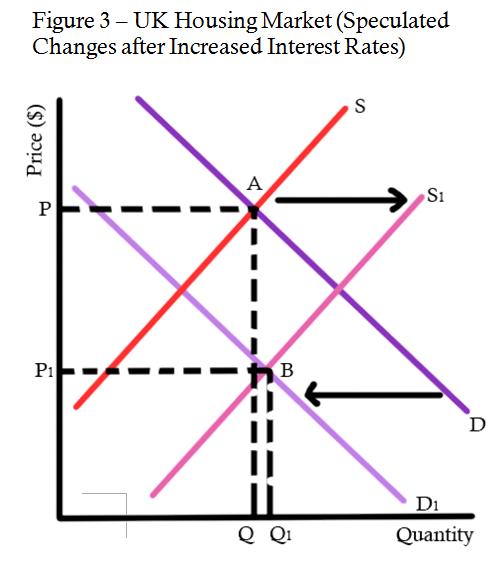
As mentioned in the article, it was forecasted that when there is a rise in interest rates in the future, the housing market may experience some falls in average price. This is because as interest rates increase, there is a higher tendency to save than spend. Thus, the demand curve shifts inwards (Figure 3, D to D1). Also, homeowners may prefer to sell their houses because of higher mortgages, shifting the supply curve outwards (S to S1). On the whole, the equilibrium would have changed from A to B, with prices falling from P to P1.

Diagram 3: UK Housing Market (Speculated Changes after Increased Interest Rates)A future increase in interest rates may affect different stakeholders in various ways; demand and supply changes may not follow what is depicted in Figure 3. Those who have high mortgage repayments may sell their homes and seek to find smaller and cheaper housing. Consequently, demand for small homes may increase, whilst demand for larger homes may decrease.

The article presents the view that in the future, there may be further price falls. This is supported by the anticipation of higher interest rates. Also, because consumer confidence is at a low due to the global economic recession, once supply catches up with demand, ceteris paribus, it may be assumed that prices will not rise any further. Hence, some economists would argue that it is most probable that prices would then fall. In addition, the increase of value added tax in January back to the previous rate of 17.5% would result in using income to compensate for the higher prices. Thus, fewer consumers would be able and willing to buy new homes and demand would drop, leading to a fall in housing prices.

However, other factors that affect demand and supply must be considered before that conclusion is made. For example in the USA, tax credit is available for homebuyers; this would increase disposable income, thus increasing demand. If this is also made available in the UK, the prices of houses may not necessarily fall. Also, because there is speculation that prices may rise, there may continue to be a shortage in supply as homeowners wait to take advantage of higher prices when they sell. Demand would also be enhanced by speculation as consumers are more willing to buy when prices are considered low, than in the future when prices may be higher. Some may also consider buying a house as an investment, because prices are predicted to rise. Thus, if these scenarios occur, price falls may not occur.

The article suggests the reasons why UK house prices rose by 1.6% and then speculates, with satisfactory reasons, why prices may fall in the future. In conclusion, the article is accurate in its justification, but does not consider the full array of alternative reasons which may affect the prices of homes.


Economic Development - Notes


Factors that determine the level of economic development:


  1. Quality & quantity of Factors of Production

    1. Capital

    2. Entrepreneurship – Singapore devoid of many natural resources but became a logistics hub

    3. Land – Malaysian rubber trees; Singapore’s natural harbour

    4. Labour – China (emerged into the global economy because of its huge supply of cheap labour that developed into a manufacturing hub)

    5. Government decisions & governance

      1. Corruption – hinders economic activity and growth

      2. Gangs & unrest – decreases economic activity (e.g. Nigeria gangs in Lohas create a protection racket under the pretence of ‘labour unions’ to extort money from bike-taxis, roadside traders…)

      3. Not clearly defined property rights & legislation


- (a.), (b.) and (c.) create allocative inefficiency which is very bad for developing countries as it disrupts the market, decreases economic activity and creates deadweight loss. [Graph]

  1. Infrastructure

  2. Strength of institution

    1. Legal system; Established property rights – greater incentive to set up businesses

    2. Politics (e.g. emerging economies: India’s democratic (short-term policies) vs China’s communist party (increased political stability; allows more time for policies to be seen through and long-term aims to be made))

    3. Natural factors


Sources of economic development:


  • Land quality


- Better planning for land use; fertilization/ irrigation of the area for primary industries

  • Land quantity


- Land reclamation (Singapore); build upwards (Hong Kong)

  • Resources


- E.g. Natural harbor – Singapore; Oil discovery – Dubai, Brazil; Gold deposits – South Africa

  1. Human factors


  • Quantity of human capital


- Baby boom; Immigration

  • Quality of human capital


- Education/ training; health awareness/ promotion; attract skilled migrants

  1. Physical capital & technology


  • Build more infrastructure (e.g. schools, hospitals, roads, housing)

  • Invest more in capital such as machinery, factories etc.

  • Promote saving & investment (e.g. by offering government assistance; loans; grants; subsidies; lowering interest rates)


Capital widening: More people have access to capital – Ratio of capital: per worker doesn’t change.

Capital deepening: Each worker has access to more capital.

  1. Institutional factors


  • Adequate banking system


- Money stays in the country, which allows banks to provide loans to firms and start-up companies, which drives investment (unlike Nigeria where all money earned is sent abroad to safeguard its value)

  • Structure of legal system with established property rights


- Encourages entrepreneurship and businesses to start-up

  • Reliable infrastructure


- Most importantly telecommunications and the internet – needed for most business transactions nowadays

- Transport networks – mobility of labour, raw materials, capital… etc.

  • Education system

  • Political stability


- E.g. China (stable, one party rule – allows the government to make long-term goals and plans for sustainable development of the country )vs India (democratic leadership – where politicians focus more on getting re-elected and tend to implement short-term policies)