Showing posts with label School systems. Show all posts

Monday, 13 December 2010

IB in 6 points

As written on the homepage of IB, this is a quick summary of what IB is.

Summing up the IB in 6 points:

  1. Every student studies 6 subjects: a first language, a second language, mathematics, a natural science, a human science and an elective which can (but doesn’t have to be) an arts/creative subject. 3 of these are done at Higher Level (equivilant to a full A-level in the UK), and 3 of them are done at Standard (equivilant to an AS level in the UK).

  2. Each subject is scored out of 7 (but don’t estimate the effort and achievement of achieving this).

  3. In addition, every student studies a course on Theory of Knowledge (TOK) and writes an extended essay (EE). Together, these can add 3 bonus points to your score.

  4. Hence, the maxium possible score is is 45. (6 subjects at 7 points each, plus 3 bonus points from ToK/Extended Essay.) This is scored by 0.2% of the world. A typical Oxbridge offer is 40 points. The average score worldwide is 30 points.

  5. ToK is a course of applied philosophy. It is designed to give students an insight into the problems of knowledge in their life, and some of the limitations of their ability to know something. The Extended Essay is a 4,000 word research essay, written over the two years of the course, on a subject chosen by the student. Both are compulsory. Failing either results in failing the diploma.

  6. As a “counterbalance” to the academic rigour of the course, every student completes around 150 hours of community service, known as CAS (Community, Action, Service).


Tuesday, 7 December 2010

A Parent's Guide to IB

A decision to do the IB is not one that should be taken lightly. A lot of people will have a variety of views on whether it is a good thing for your child. Ultimately, you have to make the decision with your child. You know more than any outside about what is best for your child, and whether the IB is suitable for them.

I firmly believe that the IB was right for me. I also believe that the IB has the potential to be a very good thing for a lot- but not every- 16-18 year old.  What I aim to do is to provide information about why you should consider the IB. I do not claim to know what is best for your child, but to give you some things that I think are worth considering.

  • The IB offers breadth. More so than the current A-level system, the IB creates rounded and balanced academics.  Students are required to study a wide range of subjects (including a compulsory MFL and mathematics). The upshot is students who are more ‘knowledgable’  in the best sense of the word. There is an attendent disadvantage: that your score in one subject affects the overal diploma score.  If you score badly, in say, maths, your overal score will be lower. More on the mechanics of that here.

  • Time. To do the IB well takes a lot of it.  The myths of IB students having no social life at all is a myth. Most of us are human, or were at one stage in our lives.  However, you are doing 7 subjects, some of which you don’t get to choose.  In order to get the very best marks, you will  be working a 60-70 hour week. (10 hours a day every day is about what I did during most of Year 2) CAS requirements also force a not-so-outgoing teen to get involved in at least one activity related to creativity, action and service. It is very hard, and do not underestimate just how much work is involved.

  • Grade Inflation. This is the big plus of the IB when considered in the British system. There is none. The same percentage of people get full marks (45) today as they did when the IB started. Likewise, the mean score is always 30 points (+/- 1 point. You can be certain that the IB you do today is worth the same as the ones sat 30 years ago. I don’t have that faith in the A-levels.

  • Uni Preparation. No other qualifcation at pre-University level makes doing a 4,000 wd essay and a course in ToK compulsory. This is precisely what universities love: it shows that you have some experience of writing university essays and makes you stand out from the crowd. Doing a CAS project might seem intimidating for your child at first, but the opportunity and experience of planning and organising an entire event/activity stands out for most universities that want pro-active and interesting student body.


Monday, 6 December 2010

IB Business Management Task: Examining Hitler as a Leader

Examining Hitler as a leader

Hitler was quite an autocratic leader, as he is infamous for his ability to make a large mass number of people follow his orders and decisions.

WHAT MAKES HIM AN AUTHORITARIAN (AUTOCRATIC LEADER)?


  • Hitler did not consult the German people for decisions, and people had no rights to oppose the laws of the Nazis. This shows that Hitler was definitely not a democratic type of leader.


EXAMPLE: Hitler did not consult the people of Germany whether he should exterminate all the Jews during the Holocaust; it was mainly based on Hitler’s strong anti-Semitic ideas. (http://en.wikipedia.org/wiki/The_Holocaust)

  • Hitler is not known for delegating tasks to other people, actions are done based on his own judgment. This shows that Hitler did not adopt a ‘laissez-faire’ type of leadership style as he sought to control every aspect of people’s life.


EXAMPLE: Hitler always had to be in charge of the affairs in Germany, he had to be in control of everything. This is shown in the Hitler Youth groups; where youths were taught follow the rules of Nazism.

  • Hitler told the people of Germany exactly what to do, for example people were ordered to join the Nazis and help the Nazi cause, like exterminating the Jews.


Why was he a good leader?


  1. Hitler was a good orator; his oratory skills were effective in persuading people to do what the Nazi’s wanted. Hitler had the skills that allowed many people to follow him, which is good for management and leadership.

  2. Hitler was quick to make decisions, he was not democratic so therefore decisions were made quickly, and because he had a lot of support they were obeyed.

  3. Hitler kept people disciplined, if he had a laissez faire type of leadership it would make his position as leader of Germany vulnerable as it didn’t keep people restrained.

  4. People believed in Hitler, and what he said was always seen as rational as Hitler had a large amount of support.

  5. Hitler’s style of leadership made people want to reform to his ways better, for example they all attended his Nazi-run organizations. This continued the support they have for him, and also it is good for self improvement for people. This is a good style in management as well, because it encourages staff to continually improve.


IMPROVEMENTS FOR HITLER AS A LEADER


  • A disadvantage for autocratic leadership is that many people tend to be de-motivated because the leader is not always amiable. Hitler controlled people out of fear, so therefore I think that Hitler should have been more democratic to keep his support, as many people had complaints about the Nazi state.

  • Situational leadership might have been good for Hitler as well, as it means that he was not always autocratic but instead democratic when needed. This would keep people disciplined AND have his continued support.


Hitler’s influence on others and their achievements


  • Hitler was effective in influencing a large section of the German population; people often followed his decisions because his influence was great.


-  People were quick to join Nazi-run organizations to become the “ideal German” where they learnt racial differences between Jews and non Jews and also Nazi ideology.

- Hitler created a very strict atmosphere in Germany where people were made to obey the laws; people often achieved a lot to satisfy the needs of the Nazis.


IB: Business Management - Notes on Marketing (Unit 4.1)

“Marketing is the identification, anticipation, and satisfaction and of customer needs and wants profitably. “

  • Marketing is important to businesses as they will need to satisfy customer needs and wants to survive and also to prevent them from buying from any rival businesses.

  • They will have to appeal to people by the use of price, product, promotion and place.

  • The right price has to be chosen because it is crucial that the customer can afford the product and so they don’t buy from other competitors

  • The right product has to be selected as the product has to be appealing to the customer in terms of size, colour, functions. This is needed to satisfy customer needs and wants

  • Promotion is crucial as they need to make consumers aware of the product and to be persuaded to buy it.

  • Place is also important because it has to be fitted to suit customer’s convenience


The marketing mix is a key part in marketing as it involves the success the product will produce if it is marketed properly.


  • A business that sells mainly to customers and private individuals(like the general public) will be called consumer markets.

  • While a business that sells to other businesses or organizations will be involved in commercial or industrial markets.

  • A business usually wants to know three things;


-          Market share that they hold

-          Market size

-          Number of competitors

-          Potential for market growth

  • MARKET SIZE is usually defined by;

  • customer base, if there is a large customer base then that means that the market is quite diverse and has a lot of opportunity of expansion(like the fast food market) while if the market is quite niche then there will be a limited customer base and therefore small market size

  • barriers to entry, if there are many natural or legal barriers of entry it restricts market size and it means that the market will have fewer suppliers as there are fewer competitors

  • location, a business may operate in certain geographic area because the market there may be more successful due to the abundant potential customers there. However, now increasing globalization prevents a market from being hindered by geographical restraints.

  • Volume of sales- if the value of sales in this market is very small then the market is not likely to be big as suppliers are not attracted into this market.


MARKET GROWTH- another thing that businesses will be interested in

  • this refers to the increase of size that a market faces over time

  • during market growth it means that more suppliers enter the market and the volume of sales go up.

  • This market growth usually attracts more suppliers in because of the potential of bigger profits.


MARKET SHARE

  • How much of the overall sales in the whole market a certain business owns.

  • This is usually used to measure success of the business over time

  • See how well the business is doing over competitors


  • Market concentration looks at the degree of competition within a market;

  • This is done by calculating the market shares of the largest firms in the market (like apple and Microsoft in the computer industry)

  • This is given by the concentration ratio, if there is a 98% concentration ratio is means that the two top competitors(apple and Microsoft) produce for 98% of the whole industry- so this will not be a very competitive industry because the small businesses only account for 2% of the whole industry

  • Such big industry-dominating businesses are called oligopolists


PRODUCT ORIENTATION

v  This is used to describe a business that focuses production on the product in itself instead of producing to satisfy customer needs and wants.

v  The product is produced in the belief that it will be sold, and it may be for popular products like the iPod

v  Sell products that they can make, rather than selling products with elevated costs due to marketing

v  Product orientation may be successful because of Say’s law (supply creates its own demand)

v  Producers are not always sure if they will sell, it is highly risky because suitable market research has not been undertaken, money for R&D may be wasted as a cause of “hit and miss” strategies

v  Many product orientated businesses may focus upon producing more luxury items where the production process may be scrutinized with more detail- so quality can be assured

MARKET ORIENTATION

  • A business that focuses upon satisfying customer needs and wants, and produces what the customer wants rather than what they can actually make

  • Usually involves market research to look into the present and future demand of the product- this is costly but it is worthwhile as it makes the product less risky and more likely to form good profits

  • A market orientated business is also flexible to changes in the market, like different trends because they can be kept up to date

  • A disadvantage for market orientation is the costs associated with it, there is not always a guarantee this method will be successful.


FACTORS THAT AFFECT MARKET OR PRODUCT ORIENTATION

  • What type of product it sells, if it is a product that is quite homogeneous then not a lot of market research will be required.

  • Organization culture- if a firm believes that customers should be placed above all then it will usually be market orientated

  • Nature of barriers to entry; firms with less competition will be more product orientated and vice versa. This is because if there are many barriers of entry there will be less suppliers in the market, so consumers don’t have such a broad range of options


Social marketing

  • Usually for a cause instead of selling of products

  • Like the government imposed adverts to prevent people from taking drugs and smoking, this is a form of social marketing

  • “an activity that affects social behavior”

  • This differs from commercial marketing because people are not persuaded to buy anything, but instead informed of causes and persuaded against a certain action

  • A challenge to social marketing is the unwillingness of people who change their social behavior due to habits

  • Clients of social marketing agencies are usually non-profit organizations and this is how it differs from profit making organizations


Tuesday, 30 November 2010

Sample Economics IA (IB)

Just a sample Economics IA to give you a feel of what it entails.


An Economics IA typically is focused on one of the 5 areas of the syllabus: Introduction in Economics, Microeconomics, Macroeconomics, International Economics or Development Economics. They require around 650-750 words in length (including diagrams, labels and footnotes).

This IA is on Microeconomics, 747 words long, and is a commentary of the original article, UK house prices rise by 1.6% in August - the largest increase since December 2006, from the DailyMail.co.uk 27/08/09.

The article:


Daily Mail

UK house prices rise by 1.6% in August - the largest increase since December 2006

By Daily Mail Reporter
Last updated at 4:24 PM on 27th August 2009

The average cost of a home in the UK jumped by 1.6 per cent during August

House prices rose for the fourth month in a row during August as the market continued to be boosted by a shortage of homes for sale, figures showed today.

The average cost of a home in the UK jumped by 1.6 per cent during the month, the biggest increase since December 2006, according to Nationwide Building Society.

The annual rate at which prices are falling also continued to ease during August, narrowing to just 2.7 per cent, down from 6.2 per cent in July.

The group said prices were now 3.2 per cent higher than at the beginning of 2009 at an average of £160,224, although it added that they were still 14.4 per cent below their peak in October 2007.

Martin Gahbauer, Nationwide's chief economist, said: 'The exceptionally low level of interest rates offers some explanation for why house prices have not repeated the very sharp falls of 2008.'

He said low interest rates had fed through into lower mortgage repayments for existing homeowners, making it easier for people who lost their jobs to continue to afford their home loan.

As a result fewer people have been forced to sell their home as is normally the case during a recession, and this has contributed to shifting the balance of supply and demand in favour of sellers during 2009.

Low interest rates have also helped make property more affordable for first-time buyers, boosting demand, despite the ongoing problems in the mortgage market.

But Mr Gahbauer warned that when interest rates did start to rise again it could make the recovery in the housing market 'bumpier' than might be expected following the recent run of price rises.

The latest figures on the property market come just days after the British Bankers' Association said the number of mortgages approved for house purchase had risen to a 17-month high during July.

The Council of Mortgage Lenders also reported a 26 per cent rise in mortgage lending in July to its highest level for nine months, as buyers continued to return to the market.

But despite the recent pick up in housing transactions, economists have warned that the number of homes changing hands still remains well down on normal levels.

The ongoing problems in the mortgage market are also continuing to limit the number of people getting on to the housing ladder, despite some recent signs that lenders are beginning to loosen their lending criteria.

As a result, it is thought any recovery in the housing market is likely to be gradual, with some commentators warning that further price falls cannot be ruled out.

The commentary:


The recent global economic recession has generated many problems worldwide, such as increased unemployment, lack of consumer confidence and reductions in salaries and wages. In the United Kingdom, housing prices also plummeted, but during August the average cost for a home rose by 1.6%. This is, according to the article, mainly because of low interest rates and shortage of supply.

Diagram 1: UK Housing Market (Demand Shift)

Low interest rates, the amount borrowers pay to lenders for the usage of the borrowed money, would result in a shift in demand, the ability and willingness to consume a commodity, to the left (Figure 1, D to D1). This is because consumers are encouraged to borrow more, which would lead to increased spending. Consequently, the equilibrium would move from A to B, resulting in an increase in price (P to P1).Diagram 2: UK Housing Market (Supply Shift)

Furthermore, low interest rates would lead to lower mortgage repayments, hence allowing homeowners, usually predicted to sell their homes during a recession, to refrain from doing so. There would be an inwards shift in supply of homes (Figure 2, S to S1), the ability and willingness to provide a commodity, as fewer owners choose to sell their houses, changing the equilibrium from B to C; the price would increase from P1 to P2. Overall, the change in price (P to P2) would amount to 1.6%.

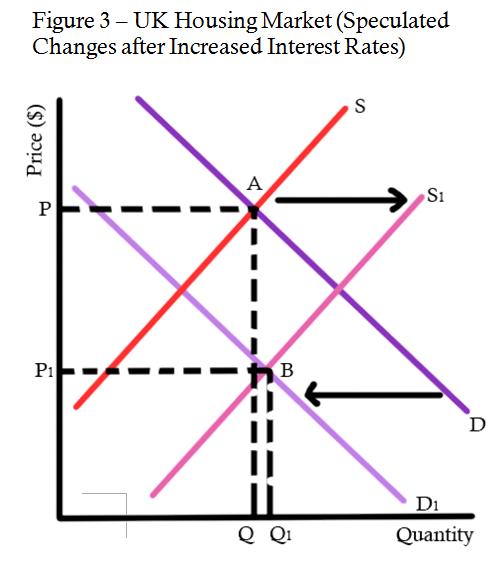
As mentioned in the article, it was forecasted that when there is a rise in interest rates in the future, the housing market may experience some falls in average price. This is because as interest rates increase, there is a higher tendency to save than spend. Thus, the demand curve shifts inwards (Figure 3, D to D1). Also, homeowners may prefer to sell their houses because of higher mortgages, shifting the supply curve outwards (S to S1). On the whole, the equilibrium would have changed from A to B, with prices falling from P to P1.

Diagram 3: UK Housing Market (Speculated Changes after Increased Interest Rates)A future increase in interest rates may affect different stakeholders in various ways; demand and supply changes may not follow what is depicted in Figure 3. Those who have high mortgage repayments may sell their homes and seek to find smaller and cheaper housing. Consequently, demand for small homes may increase, whilst demand for larger homes may decrease.

The article presents the view that in the future, there may be further price falls. This is supported by the anticipation of higher interest rates. Also, because consumer confidence is at a low due to the global economic recession, once supply catches up with demand, ceteris paribus, it may be assumed that prices will not rise any further. Hence, some economists would argue that it is most probable that prices would then fall. In addition, the increase of value added tax in January back to the previous rate of 17.5% would result in using income to compensate for the higher prices. Thus, fewer consumers would be able and willing to buy new homes and demand would drop, leading to a fall in housing prices.

However, other factors that affect demand and supply must be considered before that conclusion is made. For example in the USA, tax credit is available for homebuyers; this would increase disposable income, thus increasing demand. If this is also made available in the UK, the prices of houses may not necessarily fall. Also, because there is speculation that prices may rise, there may continue to be a shortage in supply as homeowners wait to take advantage of higher prices when they sell. Demand would also be enhanced by speculation as consumers are more willing to buy when prices are considered low, than in the future when prices may be higher. Some may also consider buying a house as an investment, because prices are predicted to rise. Thus, if these scenarios occur, price falls may not occur.

The article suggests the reasons why UK house prices rose by 1.6% and then speculates, with satisfactory reasons, why prices may fall in the future. In conclusion, the article is accurate in its justification, but does not consider the full array of alternative reasons which may affect the prices of homes.


Saturday, 6 November 2010

Brief: The International Baccalaureate Diploma System

The IB (International Baccalaureate) Diploma is a holistic educational system focused on the IB Learner profile with a mission statement of building socially and ethically conscious highschool graduates prepared for university studies. (Phew! -Long sentence!)

Besides a compulsory 6 subjects, the IB also demands that students also dedicate time to CAS (which in IB laymen terms, stand for Creative, Action, and Service extracurricular activities). Participation and demonstration of leadership skills (from a range of commitments in the arts, athletics and community service) is a vital aspect of CAS.

Pros


(for eager parents) Holistic, rigorous, demanding with a good support system from the IB organising body.

Graduates tend to feel that the IB is an experience they're happy to struggle through.

Universities see IB grads as well prepared for university study and life - the IB diploma is very indicative of a well-rounded individual.

Cons


Heavy workload both in school and after school.

It's comprehensiveness (in the 6 subject areas) and language demands may not suit students with narrower interests (eg. those who plan to solely pursue the arts).

Brief: The Ontario Canada System Review

This system is rather vigorous, with it's focus more on learning than on assessments, which suits certain types of learners. Several Canadian International Schools around the world offer this system alongside the IB.

Pros


Accepted by all Canadian universities. As Canadian universities are quite cheap for Canadian citizens (and relatively so for non-citizens), the Ontario system equals a low-cost tertiary education option.

Cons


Not always recognized in other foreign countries.