Quality points are awarded for
Clarity of expression:
clearly written responses- the examiner can read the answer once and get the meaning. It is not the handwriting that counts, it is the clarity of your answer and ideas. Be sure to write a logical progression of ideas by planning your answers so that you write in a clear logical order in each section. Avoid jumping back and forth in sequences. Drawings should not have label lines that cross, tables of comparison should be constructed with comparative feature is shown with each item to be compared.
full and complete attempts- all three sections are addressed and clearly indicated ie. 4a, 4b, 4c. DO NOT MIX SECTIONS FROM DIFFERENT QUESTIONS!
Structure of answer:
logical linking of ideas within at least 2 sections of the question- this is usually seen in the higher point value sections, not in drawings or lists. These links should be clear ideas, using additional material supporting your explanations or discussions so you really need to know the meaty details of the syllabus.
Showing posts with label smartkids. Show all posts
Showing posts with label smartkids. Show all posts
Saturday, 29 January 2011

IB Science - Multiple choice questions
Multiple choice questions come up on practically every Group 4 IB subject - be it physics, chemistry, biology, ecosystems, sports sciences and so on....... Hence thats a lot of marks given as a gift - if you know the right techniques ;)!
Firstly, get familiar with the several types of questions:
Sequences are best addressed by reading down the first item in the sequence to eliminate the choices and then proceeding across the sequences until you have only one choice remaining.
For example:
What is the correct order of taxonomic categories from largest to smallest?
Now you have only to choose between the two. Next look down the second item of the sequence to eliminate the false choice.
Finally you have the answer!
Frequently, it is easier to read down one of the columns and eliminate the items that are not correct.
The questions usually are comparative of structures or functions.
Which of the following shows the correct features of arteries and veins?
Various type of genetic crosses, pedigrees will be shown here. How to identify genotypes and inheritance patterns will be illustrated.
See the more detailed post on data response questions.
See the more detailed post on how to interpret graphs.
These questions give you a combination of three or four options. The best way to attack is to eliminate the options (I, II, III, IV) you know (feel) are incorrect and then eliminate any answers with those options. Be ready to accept all the options!
Which of the following are required for proper blood clotting?
I. Release of thrombokinase from platelets and damaged tissues
II. Damage to leucocytes
III. Prothrombin in the plasma
IV. Fibrinogen in the plasma
A. I only
B. III and IV only
C. I, III and IVonly
D. I, II, III and IV
Since leucocytes are not involved in blood clotting, this option is not required so any answer choice with II is wrong- eliminate D.
Since thrombokinase, prothrombin and fibrinogen are all needed, then C is correct answer.
The IB will present diagrams, drawings and electronmicrographs in questions. You will be asked to interpret the image for knowledge about specific details:
-- structure and function of organelles
-mitochondria
-- structure and function of cells- acini, epithelial (microvilli)
-- prokaryotic vs eukaryotic cells
-- plant vs animal cells
You should be able to accurately measure and calculate the magnification or actual size given relevant information.
Other images to interpret:
-- organs or systems- structure and function
-- food chains, pyramids, cycles
-- metabolic pathways and processes
-- DNA profiles, karyotypes, pedigrees
Firstly, get familiar with the several types of questions:
Sequence type questions
Sequences are best addressed by reading down the first item in the sequence to eliminate the choices and then proceeding across the sequences until you have only one choice remaining.
For example:
What is the correct order of taxonomic categories from largest to smallest?
- kingdom--> order--> class--> phylum --> species
- species--> order--> phylum--> kingdom--> class
- kingdom--> phylum--> class--> order--> species
- species--> order--> class--> phylum--> kingdom
Now you have only to choose between the two. Next look down the second item of the sequence to eliminate the false choice.
- kingdom--> order--> class--> phylum --> species
- kingdom--> phylum--> class--> order--> species
Finally you have the answer!
- kingdom--> phylum--> class--> order--> species
Table type questions
Frequently, it is easier to read down one of the columns and eliminate the items that are not correct.
The questions usually are comparative of structures or functions.
Which of the following shows the correct features of arteries and veins?
| ||||||||||||||||||||||||||||||
| ||||||||||||||||||||||||||||||
| ||||||||||||||||||||||||||||||
| ||||||||||||||||||||||||||||||
|
Genetics questions
Various type of genetic crosses, pedigrees will be shown here. How to identify genotypes and inheritance patterns will be illustrated.
- Crosses
- Monohybrid ( single trait)
- Dihybrid (two traits)
- Non-Mendelian crosses
- Sex-linked
- blood types
- codominant- dihybrid
- Polygenic ( multiple genes)
Data based question strategies
See the more detailed post on data response questions.
Graphical presentation questions
See the more detailed post on how to interpret graphs.
I, II, III- type
These questions give you a combination of three or four options. The best way to attack is to eliminate the options (I, II, III, IV) you know (feel) are incorrect and then eliminate any answers with those options. Be ready to accept all the options!
Which of the following are required for proper blood clotting?
I. Release of thrombokinase from platelets and damaged tissues
II. Damage to leucocytes
III. Prothrombin in the plasma
IV. Fibrinogen in the plasma
A. I only
B. III and IV only
C. I, III and IVonly
D. I, II, III and IV
Since leucocytes are not involved in blood clotting, this option is not required so any answer choice with II is wrong- eliminate D.
Since thrombokinase, prothrombin and fibrinogen are all needed, then C is correct answer.
Image interpretation
The IB will present diagrams, drawings and electronmicrographs in questions. You will be asked to interpret the image for knowledge about specific details:
-- structure and function of organelles
-mitochondria
-- structure and function of cells- acini, epithelial (microvilli)
-- prokaryotic vs eukaryotic cells
-- plant vs animal cells
You should be able to accurately measure and calculate the magnification or actual size given relevant information.
Other images to interpret:
-- organs or systems- structure and function
-- food chains, pyramids, cycles
-- metabolic pathways and processes
-- DNA profiles, karyotypes, pedigrees
IB Biology - Quick Study Tips
A brief glossary to trigger your memory
-A-
-ASE = enzymes (lactase acts on lactose, lipase acts on lipids)
Axons carry impulse Away from the cell body.
Arteries carry blood Away from the heart.
Active TransPort needs ATP,
Active transport goes Against the grAdient
Alpha cells in pancreas produce glucAgon to increAse blood sugar levels
"Animals are made of cells" said T Schwann (swans are animals)
Anion is A Negative Ion
-B-
B lymphocytes clone to make plasma cells which make antiBodies against specific antigens
-C-
Cations - Ca is a + ion
Constriction by Circular muscles Contracting - in the arteries when in the Cold, in the iris when in the dark
C and G always have 3 (cytosine and guanine pair up with 3 H bonds in DNA and RNA)
-D-
Diffusion is always Down a concentration graDient
-G-
GA for Gene HbA, GAG in DNA sense strand, GAG in mRNA, Glutamic Acid in Haemoglobin - for Sickle Cell anaemia. (see STUV)
-Gen = creation of (glycogen, fibrinongen, oestrogen)
GlucagON turns sugar ON (increase blood sugar levels by breaking down glycogen to glucose)
-H-
sHort day plants are inHibited by active Pfar-red
-I-
I D- Insulin Dependent is Diabetes type I
I I- Insulin Immune causes Diabetes type II
-In = proteins (insulin, haemoglobin, pepsin)
INsulin makes glucose go IN to cells (liver and muscles to be stored as glycogen or to be used in respiration)-
Insulin made by Beta cells- (think IB!)
-L-
Ligaments hold bones to bones in joints- think about knee injuries
Lagging strand has 3 G's, is 3 prime to 5 prime strand, has 3 DNA enzymes (DNA polymerase I and III, DNA ligase + RNA primase) and replicates DNA in fragments
-M-
Matrix in the Mitochondrion- (see S for stroma)
-O-
-ONE = steroid hormones (progesterone, oestrogen, testosterone)
-OSE = sugars (glucose, sucrose, amylose or starch, cellulose)
Oval window in ear is shaped like a stirrup
Oxygen is made early in phOtosynthesis- photolysis of water in early in LDR and is used late in respiratiOn- electron acceptor at end of electron transport chain
-P-
Photosynthate in the Phloem
Photosynthesis uses NADP/ NAPH+H (not NAD / NADH+H)
Progesterone : Pro = in favour of , gester = pregnancy, -one = steroid hormone
-R-
Ringer - characteristics of living things (Reproduction, Irritibilty, Nutrition, Growth, Excretion, Respiration)
BohR shift- low pH curves shifts to the Right
-S-
SenSe strand is like the meSSage used to make the the rubber stamp which is like the antisense strand that is replicated to make the SenSe strand which is the meSSage used to make the rubber stamp to make the meSSage......
STUV- for Sickle Cell anaemia
Gene Hb S, GTG in DNA sense strand, GUG in mRNA, Valine in Haemoglobin S (seeGA)
STroma in a chloroplaST- (see M for matrix)
-T-
Tendons hold muscles to bone- think Achilles tendon in ankle.
Transcripition of the anTisense strand of DNA
anTicodon is on t- RNA- same order as anTisense strand of DNA
-V-
Veins have Valves
-W-
WXYZ-
Water in the XYlem (sounds like Zylem)
-Y-
thYmine and cYtosine are pYrimidines (so is uracil)
-2-
2 genetically identical cells made by Mitosis (mi two sis)
-3-
3 H bonds between cytosine and guanine (3 rhymes with C and G)
3 g's in LAGGING strand, 3 DNA enzymes work on the 3 prime to 5 prime of lagging strand in DNA replication making Okazaki fragments
-5-
5 prime to 3 prime direction for replication of new DNA strand and transcription of RNA andtranslation of mRNA to polypeptide. This is because the 5 prime carbon ( 5 like fingers on your hand) of nucleotides has phosphates which bond to the 3 prime carbon of next nucleotide (3 like the 3 bumps on your elbow)
-23-
23 is haploid number of HUMAN gametes (sperm and ovum have one set of chromosomes)
-46-
46 is diploid number of HUMAN cells (somatic cells have two sets of chromsomes)- other organisms have different numbers of chromosomes
IB Biology - Data based question strategies
Data-based questions come up on Paper 2 and 3 all the time. Make sure you study the graph or information given at the start of the question.
Being able to interpret graphs is a skill that you will need for the exams.
The first step is to identify the scales and axes, looking at the units. Are the scales linear or log scales? You must show the units in your answers.
After this, pay attention to the lines and relationship of the data:
Are the lines linear (straight?) what is the slope (gradient)? Positive or negative? Do the lines cross? At what point?
Are the lines non-linear? What is the relationship- exponential, plateau, inverse, S cureve, hyperbolic, root function?
If you're finding difficulties in doing this, check out how to establish a relationship from a graph.
Sometimes the data does not show a simple relationship. For example, here are a collection of past paper data base questions.
Be sure to give the units in your answers as shown in the graphs and tables. This may seem complicated but just copy everything after the "/" on the axes or in the heading of tables. You will lose 1 mark for omitting the units! No reason to throw away a mark when PhewStressit is given to you!
Interpretation of graphs & Relationships
Being able to interpret graphs is a skill that you will need for the exams.
The first step is to identify the scales and axes, looking at the units. Are the scales linear or log scales? You must show the units in your answers.
After this, pay attention to the lines and relationship of the data:
Are the lines linear (straight?) what is the slope (gradient)? Positive or negative? Do the lines cross? At what point?
Are the lines non-linear? What is the relationship- exponential, plateau, inverse, S cureve, hyperbolic, root function?
If you're finding difficulties in doing this, check out how to establish a relationship from a graph.
Sometimes the data does not show a simple relationship. For example, here are a collection of past paper data base questions.
Calculations
Be sure to give the units in your answers as shown in the graphs and tables. This may seem complicated but just copy everything after the "/" on the axes or in the heading of tables. You will lose 1 mark for omitting the units! No reason to throw away a mark when PhewStressit is given to you!
Monday, 13 December 2010
11 Ways of Making Quick Cash @ University
Ideas to help you seek out opportunities to earn money quickly, whether you need yo fund a cheap night out, or you're saving to fund a holiday, gap year or accommodation deposit.
With deposits for accommodation and travel costs for trips home in the holidays taking their toll on bank balances, many students end up strapped for cash at different points in the year.
Sure, summer jobs and internships can provide a solid source of income, but here are some options and ideas for earning some ready money, fast – and you'll add some extra work experience oomph to your CV at the same time.
Shop for jobs locally
First of all, check out your university jobshop. These invaluable resources are usually attached to the careers service (or sometimes, the Students' Union) and offer a whole host of temporary, ad hoc or part-time work, typically with local employers.
Most jobshops have a website where you can search for vacancies and they may also have a regular newsletter that you can sign up to, to keep you informed about the latest vacancies. Even if you’re not in the market for work now, find out where your university's jobshop is in case money gets tight in future. Also, although job vacancies advertised here would expect you to have very little work experience, its always helpful to brush up on job interview skills in case competition is stiff from other cash-strapped students.
Even if you’re not in the market for work now, find out where your university's jobshop is in case money gets tight in future.
If you have more time to spare and can make a regular commitment, check local pubs, clubs and shops for spare shifts. Nursing homes and residential centres are often in need of staff too, which is excellent experience for those looking to go into careers in social care or the healthcare professions.
Find work on campus - take part in research studies or help out with admin duties
Keep your eyes open as you wander around campus too. Notice boards in corridors can hide a whole host of job opportunities.
Psychology departments often look for human 'guinea pigs' to help test out theories and experiments. You might have to commit a bit of time and make a return visit or two but it's often easy money for little effort – particularly if you have a department that runs sleep experiments! Similarly, other science departments such as food or sports may be on the lookout for volunteers.
The admin department of your university could be a good bet. Jobs can come up at times when they’re stretched, involving tasks such as data entry, envelope filling and mailing out of prospectuses. The alumni association is also worth a try as they sometimes require current students to make calls to graduates to solicit donations to the university. These are great opportunities to develop your office admin and telephone skills, which are employer-friendly additions to your CV.
You could approach the Student Union. They may take on students to help with promoting events at the union, posting flyers and sticking up posters around campus. Sometimes these roles will be paid; at other times you’ll be offered free tickets, which, if you were planning to go along anyway, can save you a fair bit of cash.
Sell your knowledge and English skills: try tutoring
If your English skills are up to par, you could always offer your services proofreading essays for international students for a small fee. On a similar note, you could consider tutoring your degree subject to GCSE and A level students. This can also help you in revising and explaining the basics of your subject area: handy if exams are fast approaching, and also good for graduate jobs interviews where a good understanding of the fundamentals of your subject can go a long way.
Market research and sales
Participate in market research. You may come across the occasional opportunity on campus but the internet is the place to go to find opportunities. As with anything online, take some care to make sure it’s genuine. A quick internet search can prevent you from getting burned – there are plenty of forums and discussion boards where you can find out if the opportunity really is too good to be true.
For something longer term, you could always consider becoming a sales rep for a catalogue company, running ‘parties’ for Avon, Virgin Vie or even Ann Summers! However, these often require initial outlay and you should bear in mind that if you’re hard up it’s likely that your friends and peers will be too and they won’t fork out for your merchandise.
If you’re artistic or crafty you could always try selling your wares; either on campus (get permission first!), at local markets, or via online trading sites such as ebay or etsy.com. Check out our article on making money from the comfort of your home or tips for budding entrepreneurs. If you’re not so blessed with talent, flogging some of your unwanted possessions could be a good stop-gap measure.
Tuesday, 7 December 2010
A Parent's Guide to IB
A decision to do the IB is not one that should be taken lightly. A lot of people will have a variety of views on whether it is a good thing for your child. Ultimately, you have to make the decision with your child. You know more than any outside about what is best for your child, and whether the IB is suitable for them.
I firmly believe that the IB was right for me. I also believe that the IB has the potential to be a very good thing for a lot- but not every- 16-18 year old. What I aim to do is to provide information about why you should consider the IB. I do not claim to know what is best for your child, but to give you some things that I think are worth considering.
I firmly believe that the IB was right for me. I also believe that the IB has the potential to be a very good thing for a lot- but not every- 16-18 year old. What I aim to do is to provide information about why you should consider the IB. I do not claim to know what is best for your child, but to give you some things that I think are worth considering.
- The IB offers breadth. More so than the current A-level system, the IB creates rounded and balanced academics. Students are required to study a wide range of subjects (including a compulsory MFL and mathematics). The upshot is students who are more ‘knowledgable’ in the best sense of the word. There is an attendent disadvantage: that your score in one subject affects the overal diploma score. If you score badly, in say, maths, your overal score will be lower. More on the mechanics of that here.
- Time. To do the IB well takes a lot of it. The myths of IB students having no social life at all is a myth. Most of us are human, or were at one stage in our lives. However, you are doing 7 subjects, some of which you don’t get to choose. In order to get the very best marks, you will be working a 60-70 hour week. (10 hours a day every day is about what I did during most of Year 2) CAS requirements also force a not-so-outgoing teen to get involved in at least one activity related to creativity, action and service. It is very hard, and do not underestimate just how much work is involved.
- Grade Inflation. This is the big plus of the IB when considered in the British system. There is none. The same percentage of people get full marks (45) today as they did when the IB started. Likewise, the mean score is always 30 points (+/- 1 point. You can be certain that the IB you do today is worth the same as the ones sat 30 years ago. I don’t have that faith in the A-levels.
- Uni Preparation. No other qualifcation at pre-University level makes doing a 4,000 wd essay and a course in ToK compulsory. This is precisely what universities love: it shows that you have some experience of writing university essays and makes you stand out from the crowd. Doing a CAS project might seem intimidating for your child at first, but the opportunity and experience of planning and organising an entire event/activity stands out for most universities that want pro-active and interesting student body.
Monday, 6 December 2010
IB: Business Management - Notes on Marketing (Unit 4.1)
“Marketing is the identification, anticipation, and satisfaction and of customer needs and wants profitably. “
The marketing mix is a key part in marketing as it involves the success the product will produce if it is marketed properly.
- Market share that they hold
- Market size
- Number of competitors
- Potential for market growth
MARKET GROWTH- another thing that businesses will be interested in
MARKET SHARE
PRODUCT ORIENTATION
v This is used to describe a business that focuses production on the product in itself instead of producing to satisfy customer needs and wants.
v The product is produced in the belief that it will be sold, and it may be for popular products like the iPod
v Sell products that they can make, rather than selling products with elevated costs due to marketing
v Product orientation may be successful because of Say’s law (supply creates its own demand)
v Producers are not always sure if they will sell, it is highly risky because suitable market research has not been undertaken, money for R&D may be wasted as a cause of “hit and miss” strategies
v Many product orientated businesses may focus upon producing more luxury items where the production process may be scrutinized with more detail- so quality can be assured
MARKET ORIENTATION
FACTORS THAT AFFECT MARKET OR PRODUCT ORIENTATION
Social marketing
- Marketing is important to businesses as they will need to satisfy customer needs and wants to survive and also to prevent them from buying from any rival businesses.
- They will have to appeal to people by the use of price, product, promotion and place.
- The right price has to be chosen because it is crucial that the customer can afford the product and so they don’t buy from other competitors
- The right product has to be selected as the product has to be appealing to the customer in terms of size, colour, functions. This is needed to satisfy customer needs and wants
- Promotion is crucial as they need to make consumers aware of the product and to be persuaded to buy it.
- Place is also important because it has to be fitted to suit customer’s convenience
The marketing mix is a key part in marketing as it involves the success the product will produce if it is marketed properly.
- A business that sells mainly to customers and private individuals(like the general public) will be called consumer markets.
- While a business that sells to other businesses or organizations will be involved in commercial or industrial markets.
- A business usually wants to know three things;
- Market share that they hold
- Market size
- Number of competitors
- Potential for market growth
- MARKET SIZE is usually defined by;
- customer base, if there is a large customer base then that means that the market is quite diverse and has a lot of opportunity of expansion(like the fast food market) while if the market is quite niche then there will be a limited customer base and therefore small market size
- barriers to entry, if there are many natural or legal barriers of entry it restricts market size and it means that the market will have fewer suppliers as there are fewer competitors
- location, a business may operate in certain geographic area because the market there may be more successful due to the abundant potential customers there. However, now increasing globalization prevents a market from being hindered by geographical restraints.
- Volume of sales- if the value of sales in this market is very small then the market is not likely to be big as suppliers are not attracted into this market.
MARKET GROWTH- another thing that businesses will be interested in
- this refers to the increase of size that a market faces over time
- during market growth it means that more suppliers enter the market and the volume of sales go up.
- This market growth usually attracts more suppliers in because of the potential of bigger profits.
MARKET SHARE
- How much of the overall sales in the whole market a certain business owns.
- This is usually used to measure success of the business over time
- See how well the business is doing over competitors
- Market concentration looks at the degree of competition within a market;
- This is done by calculating the market shares of the largest firms in the market (like apple and Microsoft in the computer industry)
- This is given by the concentration ratio, if there is a 98% concentration ratio is means that the two top competitors(apple and Microsoft) produce for 98% of the whole industry- so this will not be a very competitive industry because the small businesses only account for 2% of the whole industry
- Such big industry-dominating businesses are called oligopolists
PRODUCT ORIENTATION
v This is used to describe a business that focuses production on the product in itself instead of producing to satisfy customer needs and wants.
v The product is produced in the belief that it will be sold, and it may be for popular products like the iPod
v Sell products that they can make, rather than selling products with elevated costs due to marketing
v Product orientation may be successful because of Say’s law (supply creates its own demand)
v Producers are not always sure if they will sell, it is highly risky because suitable market research has not been undertaken, money for R&D may be wasted as a cause of “hit and miss” strategies
v Many product orientated businesses may focus upon producing more luxury items where the production process may be scrutinized with more detail- so quality can be assured
MARKET ORIENTATION
- A business that focuses upon satisfying customer needs and wants, and produces what the customer wants rather than what they can actually make
- Usually involves market research to look into the present and future demand of the product- this is costly but it is worthwhile as it makes the product less risky and more likely to form good profits
- A market orientated business is also flexible to changes in the market, like different trends because they can be kept up to date
- A disadvantage for market orientation is the costs associated with it, there is not always a guarantee this method will be successful.
FACTORS THAT AFFECT MARKET OR PRODUCT ORIENTATION
- What type of product it sells, if it is a product that is quite homogeneous then not a lot of market research will be required.
- Organization culture- if a firm believes that customers should be placed above all then it will usually be market orientated
- Nature of barriers to entry; firms with less competition will be more product orientated and vice versa. This is because if there are many barriers of entry there will be less suppliers in the market, so consumers don’t have such a broad range of options
Social marketing
- Usually for a cause instead of selling of products
- Like the government imposed adverts to prevent people from taking drugs and smoking, this is a form of social marketing
- “an activity that affects social behavior”
- This differs from commercial marketing because people are not persuaded to buy anything, but instead informed of causes and persuaded against a certain action
- A challenge to social marketing is the unwillingness of people who change their social behavior due to habits
- Clients of social marketing agencies are usually non-profit organizations and this is how it differs from profit making organizations
Tuesday, 30 November 2010
Sample Economics IA (IB)
Just a sample Economics IA to give you a feel of what it entails.
An Economics IA typically is focused on one of the 5 areas of the syllabus: Introduction in Economics, Microeconomics, Macroeconomics, International Economics or Development Economics. They require around 650-750 words in length (including diagrams, labels and footnotes).
This IA is on Microeconomics, 747 words long, and is a commentary of the original article, UK house prices rise by 1.6% in August - the largest increase since December 2006, from the DailyMail.co.uk 27/08/09.
The recent global economic recession has generated many problems worldwide, such as increased unemployment, lack of consumer confidence and reductions in salaries and wages. In the United Kingdom, housing prices also plummeted, but during August the average cost for a home rose by 1.6%. This is, according to the article, mainly because of low interest rates and shortage of supply.

Low interest rates, the amount borrowers pay to lenders for the usage of the borrowed money, would result in a shift in demand, the ability and willingness to consume a commodity, to the left (Figure 1, D to D1). This is because consumers are encouraged to borrow more, which would lead to increased spending. Consequently, the equilibrium would move from A to B, resulting in an increase in price (P to P1).
Furthermore, low interest rates would lead to lower mortgage repayments, hence allowing homeowners, usually predicted to sell their homes during a recession, to refrain from doing so. There would be an inwards shift in supply of homes (Figure 2, S to S1), the ability and willingness to provide a commodity, as fewer owners choose to sell their houses, changing the equilibrium from B to C; the price would increase from P1 to P2. Overall, the change in price (P to P2) would amount to 1.6%.
As mentioned in the article, it was forecasted that when there is a rise in interest rates in the future, the housing market may experience some falls in average price. This is because as interest rates increase, there is a higher tendency to save than spend. Thus, the demand curve shifts inwards (Figure 3, D to D1). Also, homeowners may prefer to sell their houses because of higher mortgages, shifting the supply curve outwards (S to S1). On the whole, the equilibrium would have changed from A to B, with prices falling from P to P1.
 A future increase in interest rates may affect different stakeholders in various ways; demand and supply changes may not follow what is depicted in Figure 3. Those who have high mortgage repayments may sell their homes and seek to find smaller and cheaper housing. Consequently, demand for small homes may increase, whilst demand for larger homes may decrease.
The article presents the view that in the future, there may be further price falls. This is supported by the anticipation of higher interest rates. Also, because consumer confidence is at a low due to the global economic recession, once supply catches up with demand, ceteris paribus, it may be assumed that prices will not rise any further. Hence, some economists would argue that it is most probable that prices would then fall. In addition, the increase of value added tax in January back to the previous rate of 17.5% would result in using income to compensate for the higher prices. Thus, fewer consumers would be able and willing to buy new homes and demand would drop, leading to a fall in housing prices.
However, other factors that affect demand and supply must be considered before that conclusion is made. For example in the USA, tax credit is available for homebuyers; this would increase disposable income, thus increasing demand. If this is also made available in the UK, the prices of houses may not necessarily fall. Also, because there is speculation that prices may rise, there may continue to be a shortage in supply as homeowners wait to take advantage of higher prices when they sell. Demand would also be enhanced by speculation as consumers are more willing to buy when prices are considered low, than in the future when prices may be higher. Some may also consider buying a house as an investment, because prices are predicted to rise. Thus, if these scenarios occur, price falls may not occur.
The article suggests the reasons why UK house prices rose by 1.6% and then speculates, with satisfactory reasons, why prices may fall in the future. In conclusion, the article is accurate in its justification, but does not consider the full array of alternative reasons which may affect the prices of homes.
An Economics IA typically is focused on one of the 5 areas of the syllabus: Introduction in Economics, Microeconomics, Macroeconomics, International Economics or Development Economics. They require around 650-750 words in length (including diagrams, labels and footnotes).
This IA is on Microeconomics, 747 words long, and is a commentary of the original article, UK house prices rise by 1.6% in August - the largest increase since December 2006, from the DailyMail.co.uk 27/08/09.
The article:
Daily Mail
UK house prices rise by 1.6% in August - the largest increase since December 2006
By Daily Mail Reporter
Last updated at 4:24 PM on 27th August 2009
The average cost of a home in the UK jumped by 1.6 per cent during August
House prices rose for the fourth month in a row during August as the market continued to be boosted by a shortage of homes for sale, figures showed today.
The average cost of a home in the UK jumped by 1.6 per cent during the month, the biggest increase since December 2006, according to Nationwide Building Society.
The annual rate at which prices are falling also continued to ease during August, narrowing to just 2.7 per cent, down from 6.2 per cent in July.
The group said prices were now 3.2 per cent higher than at the beginning of 2009 at an average of £160,224, although it added that they were still 14.4 per cent below their peak in October 2007.
Martin Gahbauer, Nationwide's chief economist, said: 'The exceptionally low level of interest rates offers some explanation for why house prices have not repeated the very sharp falls of 2008.'
He said low interest rates had fed through into lower mortgage repayments for existing homeowners, making it easier for people who lost their jobs to continue to afford their home loan.
As a result fewer people have been forced to sell their home as is normally the case during a recession, and this has contributed to shifting the balance of supply and demand in favour of sellers during 2009.
Low interest rates have also helped make property more affordable for first-time buyers, boosting demand, despite the ongoing problems in the mortgage market.
But Mr Gahbauer warned that when interest rates did start to rise again it could make the recovery in the housing market 'bumpier' than might be expected following the recent run of price rises.
The latest figures on the property market come just days after the British Bankers' Association said the number of mortgages approved for house purchase had risen to a 17-month high during July.
The Council of Mortgage Lenders also reported a 26 per cent rise in mortgage lending in July to its highest level for nine months, as buyers continued to return to the market.
But despite the recent pick up in housing transactions, economists have warned that the number of homes changing hands still remains well down on normal levels.
The ongoing problems in the mortgage market are also continuing to limit the number of people getting on to the housing ladder, despite some recent signs that lenders are beginning to loosen their lending criteria.
As a result, it is thought any recovery in the housing market is likely to be gradual, with some commentators warning that further price falls cannot be ruled out.
The commentary:
The recent global economic recession has generated many problems worldwide, such as increased unemployment, lack of consumer confidence and reductions in salaries and wages. In the United Kingdom, housing prices also plummeted, but during August the average cost for a home rose by 1.6%. This is, according to the article, mainly because of low interest rates and shortage of supply.

Low interest rates, the amount borrowers pay to lenders for the usage of the borrowed money, would result in a shift in demand, the ability and willingness to consume a commodity, to the left (Figure 1, D to D1). This is because consumers are encouraged to borrow more, which would lead to increased spending. Consequently, the equilibrium would move from A to B, resulting in an increase in price (P to P1).

Furthermore, low interest rates would lead to lower mortgage repayments, hence allowing homeowners, usually predicted to sell their homes during a recession, to refrain from doing so. There would be an inwards shift in supply of homes (Figure 2, S to S1), the ability and willingness to provide a commodity, as fewer owners choose to sell their houses, changing the equilibrium from B to C; the price would increase from P1 to P2. Overall, the change in price (P to P2) would amount to 1.6%.
As mentioned in the article, it was forecasted that when there is a rise in interest rates in the future, the housing market may experience some falls in average price. This is because as interest rates increase, there is a higher tendency to save than spend. Thus, the demand curve shifts inwards (Figure 3, D to D1). Also, homeowners may prefer to sell their houses because of higher mortgages, shifting the supply curve outwards (S to S1). On the whole, the equilibrium would have changed from A to B, with prices falling from P to P1.
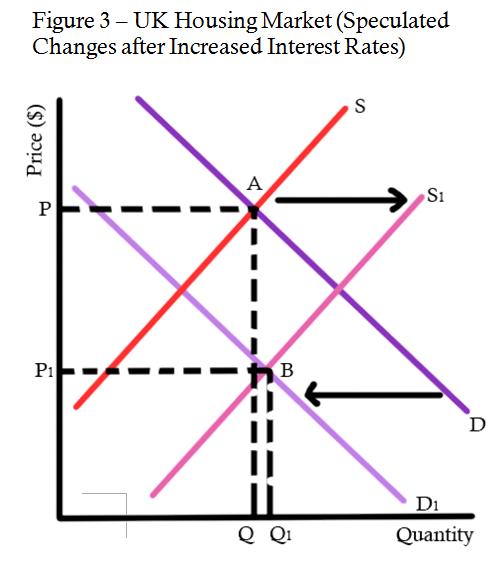 A future increase in interest rates may affect different stakeholders in various ways; demand and supply changes may not follow what is depicted in Figure 3. Those who have high mortgage repayments may sell their homes and seek to find smaller and cheaper housing. Consequently, demand for small homes may increase, whilst demand for larger homes may decrease.
The article presents the view that in the future, there may be further price falls. This is supported by the anticipation of higher interest rates. Also, because consumer confidence is at a low due to the global economic recession, once supply catches up with demand, ceteris paribus, it may be assumed that prices will not rise any further. Hence, some economists would argue that it is most probable that prices would then fall. In addition, the increase of value added tax in January back to the previous rate of 17.5% would result in using income to compensate for the higher prices. Thus, fewer consumers would be able and willing to buy new homes and demand would drop, leading to a fall in housing prices.
However, other factors that affect demand and supply must be considered before that conclusion is made. For example in the USA, tax credit is available for homebuyers; this would increase disposable income, thus increasing demand. If this is also made available in the UK, the prices of houses may not necessarily fall. Also, because there is speculation that prices may rise, there may continue to be a shortage in supply as homeowners wait to take advantage of higher prices when they sell. Demand would also be enhanced by speculation as consumers are more willing to buy when prices are considered low, than in the future when prices may be higher. Some may also consider buying a house as an investment, because prices are predicted to rise. Thus, if these scenarios occur, price falls may not occur.
The article suggests the reasons why UK house prices rose by 1.6% and then speculates, with satisfactory reasons, why prices may fall in the future. In conclusion, the article is accurate in its justification, but does not consider the full array of alternative reasons which may affect the prices of homes.
Economic Development - Notes
Factors that determine the level of economic development:
- Quality & quantity of Factors of Production
- Capital
- Entrepreneurship – Singapore devoid of many natural resources but became a logistics hub
- Land – Malaysian rubber trees; Singapore’s natural harbour
- Labour – China (emerged into the global economy because of its huge supply of cheap labour that developed into a manufacturing hub)
- Government decisions & governance
- Corruption – hinders economic activity and growth
- Gangs & unrest – decreases economic activity (e.g. Nigeria gangs in Lohas create a protection racket under the pretence of ‘labour unions’ to extort money from bike-taxis, roadside traders…)
- Not clearly defined property rights & legislation
- (a.), (b.) and (c.) create allocative inefficiency which is very bad for developing countries as it disrupts the market, decreases economic activity and creates deadweight loss. [Graph]
- Infrastructure
- Strength of institution
- Legal system; Established property rights – greater incentive to set up businesses
- Politics (e.g. emerging economies: India’s democratic (short-term policies) vs China’s communist party (increased political stability; allows more time for policies to be seen through and long-term aims to be made))
- Natural factors
Sources of economic development:
- Land quality
- Better planning for land use; fertilization/ irrigation of the area for primary industries
- Land quantity
- Land reclamation (Singapore); build upwards (Hong Kong)
- Resources
- E.g. Natural harbor – Singapore; Oil discovery – Dubai, Brazil; Gold deposits – South Africa
- Human factors
- Quantity of human capital
- Baby boom; Immigration
- Quality of human capital
- Education/ training; health awareness/ promotion; attract skilled migrants
- Physical capital & technology
- Build more infrastructure (e.g. schools, hospitals, roads, housing)
- Invest more in capital such as machinery, factories etc.
- Promote saving & investment (e.g. by offering government assistance; loans; grants; subsidies; lowering interest rates)
Capital widening: More people have access to capital – Ratio of capital: per worker doesn’t change.
Capital deepening: Each worker has access to more capital.
- Institutional factors
- Adequate banking system
- Money stays in the country, which allows banks to provide loans to firms and start-up companies, which drives investment (unlike Nigeria where all money earned is sent abroad to safeguard its value)
- Structure of legal system with established property rights
- Encourages entrepreneurship and businesses to start-up
- Reliable infrastructure
- Most importantly telecommunications and the internet – needed for most business transactions nowadays
- Transport networks – mobility of labour, raw materials, capital… etc.
- Education system
- Political stability
- E.g. China (stable, one party rule – allows the government to make long-term goals and plans for sustainable development of the country )vs India (democratic leadership – where politicians focus more on getting re-elected and tend to implement short-term policies)
Friday, 12 November 2010
Guide to Completing Your UCAS Form Online
to make the process less painful...
Reference
Once you confirmed your choice, ask your teacher to write a reference for you as soon as possible - your teachers probably already have a lot on their minds and other things to do besides your reference. Reminding them not only ensures that you'll get your application done as soon as possible, but also show them that you are a committed and responsible student.
Write your personal statement
Offers
Offers may start to come through as soon as 2 weeks after you’ve sent off your UCAS form. But don’t worry if you don’t get replies straight away. Most students applying through UCAS normally have to wait about a month before they start getting offers back, and they normally stop sending replies around May.
Once you have received replies from all the Universities you’ve applied to you then need to choose your best 2, your first choice and your insurance choice (just in case you don’t get the grades for your first choice). Send this back to UCAS who will let the universities know your choices - it is extremely important to keep all letters from UCAS and to reply to them otherwise you could lose your place.
First Things First.
- Make a note of your username and password
- Keep all information about courses/ applying/ personal statement together in a folder
- Be careful with basic info like DOB; don’t say 01/09/06!
- If you were born in the UK, there’s is no need to put in ‘date of first entry to UK’
- Keep the dates of the deadlines someplace where you can always see them - it's easy to let time fly by and be forced to rush your final application.
Research the Courses and Universities you’re interested in
- College/University prospectuses, find these in the study area.
- UCAS website: www.ucas.co.uk
- Aim higher website www.aimhigher.ac.uk or www.ahgtm.ac.uk
- UCAS Directory – all courses and codes for all universities are listed here. I personally don't feel that searching for courses on the UCAS site is as useful as actually visiting the websites of the universities you are interested in
- UCAS ‘The Big Guide’
- University websites, the local Universities are on handout K3
How to decide which is the right course for you?
- Find out what is the course is about and what it entails.
- Does it reflect your area of interest and suit your style of learning?
- What are the prospects at the end of it? Where do the students go? What jobs did they get? Believe it or not, in 3/ 4 years time, applying for UCAS seems a breeze to looking for a job!
- Do most students go on to do post-graduate courses?
- You are entirely entitled to ask questions - make the most out of contacting admissions officers about any issues you have when researchin
- And once again, check out the content of the course before writing your personal statement!
Reference
Once you confirmed your choice, ask your teacher to write a reference for you as soon as possible - your teachers probably already have a lot on their minds and other things to do besides your reference. Reminding them not only ensures that you'll get your application done as soon as possible, but also show them that you are a committed and responsible student.
Write your personal statement
Other useful information
- You can apply for more than one course at the same institution but make sure that your personal statement is relevant for all the courses you are applying for. Converse to popular belief, applying to 2 courses you really love in the same university in some cases makes it clear to admissions officers that you rally want to study there.
- The uni’s that you apply for will not know about your other choices
- List the courses you are applying for in alphabetical order, not in your order of preference.
Before submitting your final application
- Have you filled in all sections of the application form?
- ‘Additional information’ will be deleted later and will not be sent to the HE institution or university so will not bias your application in any way
Offers
Offers may start to come through as soon as 2 weeks after you’ve sent off your UCAS form. But don’t worry if you don’t get replies straight away. Most students applying through UCAS normally have to wait about a month before they start getting offers back, and they normally stop sending replies around May.
Once you have received replies from all the Universities you’ve applied to you then need to choose your best 2, your first choice and your insurance choice (just in case you don’t get the grades for your first choice). Send this back to UCAS who will let the universities know your choices - it is extremely important to keep all letters from UCAS and to reply to them otherwise you could lose your place.
Thursday, 28 October 2010
Why nerds are unpopular
"When we were in junior high school, my friend Rich and I made a map of the school lunch tables according to popularity. This was easy to do, because kids only ate lunch with others of about the same popularity. We graded them from A to E. A tables were full of football players and cheerleaders and so on. E tables contained the kids with mild cases of Down's Syndrome, what in the language of the time we called "retards."
We sat at a D table, as low as you could get without looking physically different. We were not being especially candid to grade ourselves as D. It would have taken a deliberate lie to say otherwise. Everyone in the school knew exactly how popular everyone else was, including us.
My stock gradually rose during high school. Puberty finally arrived; I became a decent soccer player; I started a scandalous underground newspaper. So I've seen a good part of the popularity landscape.
I know a lot of people who were nerds in school, and they all tell the same story: there is a strong correlation between being smart and being a nerd, and an even stronger inverse correlation between being a nerd and being popular. Being smart seems to make you unpopular.
Why? To someone in school now, that may seem an odd question to ask. The mere fact is so overwhelming that it may seem strange to imagine that it could be any other way. But it could. Being smart doesn't make you an outcast in elementary school. Nor does it harm you in the real world. Nor, as far as I can tell, is the problem so bad in most other countries. But in a typical American secondary school, being smart is likely to make your life difficult. Why?
The key to this mystery is to rephrase the question slightly. Why don't smart kids make themselves popular? If they're so smart, why don't they figure out how popularity works and beat the system, just as they do for standardized tests?
One argument says that this would be impossible, that the smart kids are unpopular because the other kids envy them for being smart, and nothing they could do could make them popular. I wish. If the other kids in junior high school envied me, they did a great job of concealing it. And in any case, if being smart were really an enviable quality, the girls would have broken ranks. The guys that guys envy, girls like.
In the schools I went to, being smart just didn't matter much. Kids didn't admire it or despise it. All other things being equal, they would have preferred to be on the smart side of average rather than the dumb side, but intelligence counted far less than, say, physical appearance, charisma, or athletic ability.
So if intelligence in itself is not a factor in popularity, why are smart kids so consistently unpopular? The answer, I think, is that they don't really want to be popular.
If someone had told me that at the time, I would have laughed at him. Being unpopular in school makes kids miserable, some of them so miserable that they commit suicide. Telling me that I didn't want to be popular would have seemed like telling someone dying of thirst in a desert that he didn't want a glass of water. Of course I wanted to be popular.
But in fact I didn't, not enough. There was something else I wanted more: to be smart. Not simply to do well in school, though that counted for something, but to design beautiful rockets, or to write well, or to understand how to program computers. In general, to make great things.
At the time I never tried to separate my wants and weigh them against one another. If I had, I would have seen that being smart was more important. If someone had offered me the chance to be the most popular kid in school, but only at the price of being of average intelligence (humor me here), I wouldn't have taken it.
Much as they suffer from their unpopularity, I don't think many nerds would. To them the thought of average intelligence is unbearable. But most kids would take that deal. For half of them, it would be a step up. Even for someone in the eightieth percentile (assuming, as everyone seemed to then, that intelligence is a scalar), who wouldn't drop thirty points in exchange for being loved and admired by everyone?
And that, I think, is the root of the problem. Nerds serve two masters. They want to be popular, certainly, but they want even more to be smart. And popularity is not something you can do in your spare time, not in the fiercely competitive environment of an American secondary school.
Alberti, arguably the archetype of the Renaissance Man, writes that "no art, however minor, demands less than total dedication if you want to excel in it." I wonder if anyone in the world works harder at anything than American school kids work at popularity. Navy SEALs and neurosurgery residents seem slackers by comparison. They occasionally take vacations; some even have hobbies. An American teenager may work at being popular every waking hour, 365 days a year.
I don't mean to suggest they do this consciously. Some of them truly are little Machiavellis, but what I really mean here is that teenagers are always on duty as conformists.
For example, teenage kids pay a great deal of attention to clothes. They don't consciously dress to be popular. They dress to look good. But to who? To the other kids. Other kids' opinions become their definition of right, not just for clothes, but for almost everything they do, right down to the way they walk. And so every effort they make to do things "right" is also, consciously or not, an effort to be more popular.
Nerds don't realize this. They don't realize that it takes work to be popular. In general, people outside some very demanding field don't realize the extent to which success depends on constant (though often unconscious) effort. For example, most people seem to consider the ability to draw as some kind of innate quality, like being tall. In fact, most people who "can draw" like drawing, and have spent many hours doing it; that's why they're good at it. Likewise, popular isn't just something you are or you aren't, but something you make yourself.
The main reason nerds are unpopular is that they have other things to think about. Their attention is drawn to books or the natural world, not fashions and parties. They're like someone trying to play soccer while balancing a glass of water on his head. Other players who can focus their whole attention on the game beat them effortlessly, and wonder why they seem so incapable.
Even if nerds cared as much as other kids about popularity, being popular would be more work for them. The popular kids learned to be popular, and to want to be popular, the same way the nerds learned to be smart, and to want to be smart: from their parents. While the nerds were being trained to get the right answers, the popular kids were being trained to please.
So far I've been finessing the relationship between smart and nerd, using them as if they were interchangeable. In fact it's only the context that makes them so. A nerd is someone who isn't socially adept enough. But "enough" depends on where you are. In a typical American school, standards for coolness are so high (or at least, so specific) that you don't have to be especially awkward to look awkward by comparison.
Few smart kids can spare the attention that popularity requires. Unless they also happen to be good-looking, natural athletes, or siblings of popular kids, they'll tend to become nerds. And that's why smart people's lives are worst between, say, the ages of eleven and seventeen. Life at that age revolves far more around popularity than before or after.
Before that, kids' lives are dominated by their parents, not by other kids. Kids do care what their peers think in elementary school, but this isn't their whole life, as it later becomes.
Around the age of eleven, though, kids seem to start treating their family as a day job. They create a new world among themselves, and standing in this world is what matters, not standing in their family. Indeed, being in trouble in their family can win them points in the world they care about.
The problem is, the world these kids create for themselves is at first a very crude one. If you leave a bunch of eleven-year-olds to their own devices, what you get is Lord of the Flies. Like a lot of American kids, I read this book in school. Presumably it was not a coincidence. Presumably someone wanted to point out to us that we were savages, and that we had made ourselves a cruel and stupid world. This was too subtle for me. While the book seemed entirely believable, I didn't get the additional message. I wish they had just told us outright that we were savages and our world was stupid.
Nerds would find their unpopularity more bearable if it merely caused them to be ignored. Unfortunately, to be unpopular in school is to be actively persecuted.
Why? Once again, anyone currently in school might think this a strange question to ask. How could things be any other way? But they could be. Adults don't normally persecute nerds. Why do teenage kids do it?
Partly because teenagers are still half children, and many children are just intrinsically cruel. Some torture nerds for the same reason they pull the legs off spiders. Before you develop a conscience, torture is amusing.
Another reason kids persecute nerds is to make themselves feel better. When you tread water, you lift yourself up by pushing water down. Likewise, in any social hierarchy, people unsure of their own position will try to emphasize it by maltreating those they think rank below. I've read that this is why poor whites in the United States are the group most hostile to blacks.
But I think the main reason other kids persecute nerds is that it's part of the mechanism of popularity. Popularity is only partially about individual attractiveness. It's much more about alliances. To become more popular, you need to be constantly doing things that bring you close to other popular people, and nothing brings people closer than a common enemy.
Like a politician who wants to distract voters from bad times at home, you can create an enemy if there isn't a real one. By singling out and persecuting a nerd, a group of kids from higher in the hierarchy create bonds between themselves. Attacking an outsider makes them all insiders. This is why the worst cases of bullying happen with groups. Ask any nerd: you get much worse treatment from a group of kids than from any individual bully, however sadistic.
If it's any consolation to the nerds, it's nothing personal. The group of kids who band together to pick on you are doing the same thing, and for the same reason, as a bunch of guys who get together to go hunting. They don't actually hate you. They just need something to chase.
Because they're at the bottom of the scale, nerds are a safe target for the entire school. If I remember correctly, the most popular kids don't persecute nerds; they don't need to stoop to such things. Most of the persecution comes from kids lower down, the nervous middle classes.
The trouble is, there are a lot of them. The distribution of popularity is not a pyramid, but tapers at the bottom like a pear. The least popular group is quite small. (I believe we were the only D table in our cafeteria map.) So there are more people who want to pick on nerds than there are nerds.
As well as gaining points by distancing oneself from unpopular kids, one loses points by being close to them. A woman I know says that in high school she liked nerds, but was afraid to be seen talking to them because the other girls would make fun of her. Unpopularity is a communicable disease; kids too nice to pick on nerds will still ostracize them in self-defense.
It's no wonder, then, that smart kids tend to be unhappy in middle school and high school. Their other interests leave them little attention to spare for popularity, and since popularity resembles a zero-sum game, this in turn makes them targets for the whole school. And the strange thing is, this nightmare scenario happens without any conscious malice, merely because of the shape of the situation.
For me the worst stretch was junior high, when kid culture was new and harsh, and the specialization that would later gradually separate the smarter kids had barely begun. Nearly everyone I've talked to agrees: the nadir is somewhere between eleven and fourteen.
In our school it was eighth grade, which was ages twelve and thirteen for me. There was a brief sensation that year when one of our teachers overheard a group of girls waiting for the school bus, and was so shocked that the next day she devoted the whole class to an eloquent plea not to be so cruel to one another.
It didn't have any noticeable effect. What struck me at the time was that she was surprised. You mean she doesn't know the kind of things they say to one another? You mean this isn't normal?
It's important to realize that, no, the adults don't know what the kids are doing to one another. They know, in the abstract, that kids are monstrously cruel to one another, just as we know in the abstract that people get tortured in poorer countries. But, like us, they don't like to dwell on this depressing fact, and they don't see evidence of specific abuses unless they go looking for it.
Public school teachers are in much the same position as prison wardens. Wardens' main concern is to keep the prisoners on the premises. They also need to keep them fed, and as far as possible prevent them from killing one another. Beyond that, they want to have as little to do with the prisoners as possible, so they leave them to create whatever social organization they want. From what I've read, the society that the prisoners create is warped, savage, and pervasive, and it is no fun to be at the bottom of it.
In outline, it was the same at the schools I went to. The most important thing was to stay on the premises. While there, the authorities fed you, prevented overt violence, and made some effort to teach you something. But beyond that they didn't want to have too much to do with the kids. Like prison wardens, the teachers mostly left us to ourselves. And, like prisoners, the culture we created was barbaric.
Why is the real world more hospitable to nerds? It might seem that the answer is simply that it's populated by adults, who are too mature to pick on one another. But I don't think this is true. Adults in prison certainly pick on one another. And so, apparently, do society wives; in some parts of Manhattan, life for women sounds like a continuation of high school, with all the same petty intrigues.
I think the important thing about the real world is not that it's populated by adults, but that it's very large, and the things you do have real effects. That's what school, prison, and ladies-who-lunch all lack. The inhabitants of all those worlds are trapped in little bubbles where nothing they do can have more than a local effect. Naturally these societies degenerate into savagery. They have no function for their form to follow.
When the things you do have real effects, it's no longer enough just to be pleasing. It starts to be important to get the right answers, and that's where nerds show to advantage. Bill Gates will of course come to mind. Though notoriously lacking in social skills, he gets the right answers, at least as measured in revenue.
The other thing that's different about the real world is that it's much larger. In a large enough pool, even the smallest minorities can achieve a critical mass if they clump together. Out in the real world, nerds collect in certain places and form their own societies where intelligence is the most important thing. Sometimes the current even starts to flow in the other direction: sometimes, particularly in university math and science departments, nerds deliberately exaggerate their awkwardness in order to seem smarter. John Nash so admired Norbert Wiener that he adopted his habit of touching the wall as he walked down a corridor.
As a thirteen-year-old kid, I didn't have much more experience of the world than what I saw immediately around me. The warped little world we lived in was, I thought, the world. The world seemed cruel and boring, and I'm not sure which was worse.
Because I didn't fit into this world, I thought that something must be wrong with me. I didn't realize that the reason we nerds didn't fit in was that in some ways we were a step ahead. We were already thinking about the kind of things that matter in the real world, instead of spending all our time playing an exacting but mostly pointless game like the others.
We were a bit like an adult would be if he were thrust back into middle school. He wouldn't know the right clothes to wear, the right music to like, the right slang to use. He'd seem to the kids a complete alien. The thing is, he'd know enough not to care what they thought. We had no such confidence.
A lot of people seem to think it's good for smart kids to be thrown together with "normal" kids at this stage of their lives. Perhaps. But in at least some cases the reason the nerds don't fit in really is that everyone else is crazy. I remember sitting in the audience at a "pep rally" at my high school, watching as the cheerleaders threw an effigy of an opposing player into the audience to be torn to pieces. I felt like an explorer witnessing some bizarre tribal ritual.
If I could go back and give my thirteen year old self some advice, the main thing I'd tell him would be to stick his head up and look around. I didn't really grasp it at the time, but the whole world we lived in was as fake as a Twinkie. Not just school, but the entire town. Why do people move to suburbia? To have kids! So no wonder it seemed boring and sterile. The whole place was a giant nursery, an artificial town created explicitly for the purpose of breeding children.
Where I grew up, it felt as if there was nowhere to go, and nothing to do. This was no accident. Suburbs are deliberately designed to exclude the outside world, because it contains things that could endanger children.
And as for the schools, they were just holding pens within this fake world. Officially the purpose of schools is to teach kids. In fact their primary purpose is to keep kids locked up in one place for a big chunk of the day so adults can get things done. And I have no problem with this: in a specialized industrial society, it would be a disaster to have kids running around loose.
What bothers me is not that the kids are kept in prisons, but that (a) they aren't told about it, and (b) the prisons are run mostly by the inmates. Kids are sent off to spend six years memorizing meaningless facts in a world ruled by a caste of giants who run after an oblong brown ball, as if this were the most natural thing in the world. And if they balk at this surreal cocktail, they're called misfits.
Life in this twisted world is stressful for the kids. And not just for the nerds. Like any war, it's damaging even to the winners.
Adults can't avoid seeing that teenage kids are tormented. So why don't they do something about it? Because they blame it on puberty. The reason kids are so unhappy, adults tell themselves, is that monstrous new chemicals, hormones, are now coursing through their bloodstream and messing up everything. There's nothing wrong with the system; it's just inevitable that kids will be miserable at that age.
This idea is so pervasive that even the kids believe it, which probably doesn't help. Someone who thinks his feet naturally hurt is not going to stop to consider the possibility that he is wearing the wrong size shoes.
I'm suspicious of this theory that thirteen-year-old kids are intrinsically messed up. If it's physiological, it should be universal. Are Mongol nomads all nihilists at thirteen? I've read a lot of history, and I have not seen a single reference to this supposedly universal fact before the twentieth century. Teenage apprentices in the Renaissance seem to have been cheerful and eager. They got in fights and played tricks on one another of course (Michelangelo had his nose broken by a bully), but they weren't crazy.
As far as I can tell, the concept of the hormone-crazed teenager is coeval with suburbia. I don't think this is a coincidence. I think teenagers are driven crazy by the life they're made to lead. Teenage apprentices in the Renaissance were working dogs. Teenagers now are neurotic lapdogs. Their craziness is the craziness of the idle everywhere.
When I was in school, suicide was a constant topic among the smarter kids. No one I knew did it, but several planned to, and some may have tried. Mostly this was just a pose. Like other teenagers, we loved the dramatic, and suicide seemed very dramatic. But partly it was because our lives were at times genuinely miserable.
Bullying was only part of the problem. Another problem, and possibly an even worse one, was that we never had anything real to work on. Humans like to work; in most of the world, your work is your identity. And all the work we did was pointless, or seemed so at the time.
At best it was practice for real work we might do far in the future, so far that we didn't even know at the time what we were practicing for. More often it was just an arbitrary series of hoops to jump through, words without content designed mainly for testability. (The three main causes of the Civil War were.... Test: List the three main causes of the Civil War.)
And there was no way to opt out. The adults had agreed among themselves that this was to be the route to college. The only way to escape this empty life was to submit to it.
Teenage kids used to have a more active role in society. In pre-industrial times, they were all apprentices of one sort or another, whether in shops or on farms or even on warships. They weren't left to create their own societies. They were junior members of adult societies.
Teenagers seem to have respected adults more then, because the adults were the visible experts in the skills they were trying to learn. Now most kids have little idea what their parents do in their distant offices, and see no connection (indeed, there is precious little) between schoolwork and the work they'll do as adults.
And if teenagers respected adults more, adults also had more use for teenagers. After a couple years' training, an apprentice could be a real help. Even the newest apprentice could be made to carry messages or sweep the workshop.
Now adults have no immediate use for teenagers. They would be in the way in an office. So they drop them off at school on their way to work, much as they might drop the dog off at a kennel if they were going away for the weekend.
What happened? We're up against a hard one here. The cause of this problem is the same as the cause of so many present ills: specialization. As jobs become more specialized, we have to train longer for them. Kids in pre-industrial times started working at about 14 at the latest; kids on farms, where most people lived, began far earlier. Now kids who go to college don't start working full-time till 21 or 22. With some degrees, like MDs and PhDs, you may not finish your training till 30.
Teenagers now are useless, except as cheap labor in industries like fast food, which evolved to exploit precisely this fact. In almost any other kind of work, they'd be a net loss. But they're also too young to be left unsupervised. Someone has to watch over them, and the most efficient way to do this is to collect them together in one place. Then a few adults can watch all of them.
If you stop there, what you're describing is literally a prison, albeit a part-time one. The problem is, many schools practically do stop there. The stated purpose of schools is to educate the kids. But there is no external pressure to do this well. And so most schools do such a bad job of teaching that the kids don't really take it seriously-- not even the smart kids. Much of the time we were all, students and teachers both, just going through the motions.
In my high school French class we were supposed to read Hugo'sLes Miserables. I don't think any of us knew French well enough to make our way through this enormous book. Like the rest of the class, I just skimmed the Cliff's Notes. When we were given a test on the book, I noticed that the questions sounded odd. They were full of long words that our teacher wouldn't have used. Where had these questions come from? From the Cliff's Notes, it turned out. The teacher was using them too. We were all just pretending.
There are certainly great public school teachers. The energy and imagination of my fourth grade teacher, Mr. Mihalko, made that year something his students still talk about, thirty years later. But teachers like him were individuals swimming upstream. They couldn't fix the system.
In almost any group of people you'll find hierarchy. When groups of adults form in the real world, it's generally for some common purpose, and the leaders end up being those who are best at it. The problem with most schools is, they have no purpose. But hierarchy there must be. And so the kids make one out of nothing.
We have a phrase to describe what happens when rankings have to be created without any meaningful criteria. We say that the situation degenerates into a popularity contest. And that's exactly what happens in most American schools. Instead of depending on some real test, one's rank depends mostly on one's ability to increase one's rank. It's like the court of Louis XIV. There is no external opponent, so the kids become one another's opponents.
When there is some real external test of skill, it isn't painful to be at the bottom of the hierarchy. A rookie on a football team doesn't resent the skill of the veteran; he hopes to be like him one day and is happy to have the chance to learn from him. The veteran may in turn feel a sense of noblesse oblige. And most importantly, their status depends on how well they do against opponents, not on whether they can push the other down.
Court hierarchies are another thing entirely. This type of society debases anyone who enters it. There is neither admiration at the bottom, nor noblesse oblige at the top. It's kill or be killed.
This is the sort of society that gets created in American secondary schools. And it happens because these schools have no real purpose beyond keeping the kids all in one place for a certain number of hours each day. What I didn't realize at the time, and in fact didn't realize till very recently, is that the twin horrors of school life, the cruelty and the boredom, both have the same cause.
The mediocrity of American public schools has worse consequences than just making kids unhappy for six years. It breeds a rebelliousness that actively drives kids away from the things they're supposed to be learning.
Like many nerds, probably, it was years after high school before I could bring myself to read anything we'd been assigned then. And I lost more than books. I mistrusted words like "character" and "integrity" because they had been so debased by adults. As they were used then, these words all seemed to mean the same thing: obedience. The kids who got praised for these qualities tended to be at best dull-witted prize bulls, and at worst facile schmoozers. If that was what character and integrity were, I wanted no part of them.
The word I most misunderstood was "tact." As used by adults, it seemed to mean keeping your mouth shut. I assumed it was derived from the same root as "tacit" and "taciturn," and that it literally meant being quiet. I vowed that I would never be tactful; they were never going to shut me up. In fact, it's derived from the same root as "tactile," and what it means is to have a deft touch. Tactful is the opposite of clumsy. I don't think I learned this until college.
Nerds aren't the only losers in the popularity rat race. Nerds are unpopular because they're distracted. There are other kids who deliberately opt out because they're so disgusted with the whole process.
Teenage kids, even rebels, don't like to be alone, so when kids opt out of the system, they tend to do it as a group. At the schools I went to, the focus of rebellion was drug use, specifically marijuana. The kids in this tribe wore black concert t-shirts and were called "freaks."
Freaks and nerds were allies, and there was a good deal of overlap between them. Freaks were on the whole smarter than other kids, though never studying (or at least never appearing to) was an important tribal value. I was more in the nerd camp, but I was friends with a lot of freaks.
They used drugs, at least at first, for the social bonds they created. It was something to do together, and because the drugs were illegal, it was a shared badge of rebellion.
I'm not claiming that bad schools are the whole reason kids get into trouble with drugs. After a while, drugs have their own momentum. No doubt some of the freaks ultimately used drugs to escape from other problems-- trouble at home, for example. But, in my school at least, the reason most kids started using drugs was rebellion. Fourteen-year-olds didn't start smoking pot because they'd heard it would help them forget their problems. They started because they wanted to join a different tribe.
Misrule breeds rebellion; this is not a new idea. And yet the authorities still for the most part act as if drugs were themselves the cause of the problem.
The real problem is the emptiness of school life. We won't see solutions till adults realize that. The adults who may realize it first are the ones who were themselves nerds in school. Do you want your kids to be as unhappy in eighth grade as you were? I wouldn't. Well, then, is there anything we can do to fix things? Almost certainly. There is nothing inevitable about the current system. It has come about mostly by default.
Adults, though, are busy. Showing up for school plays is one thing. Taking on the educational bureaucracy is another. Perhaps a few will have the energy to try to change things. I suspect the hardest part is realizing that you can.
Nerds still in school should not hold their breath. Maybe one day a heavily armed force of adults will show up in helicopters to rescue you, but they probably won't be coming this month. Any immediate improvement in nerds' lives is probably going to have to come from the nerds themselves.
Merely understanding the situation they're in should make it less painful. Nerds aren't losers. They're just playing a different game, and a game much closer to the one played in the real world. Adults know this. It's hard to find successful adults now who don't claim to have been nerds in high school.
It's important for nerds to realize, too, that school is not life. School is a strange, artificial thing, half sterile and half feral. It's all-encompassing, like life, but it isn't the real thing. It's only temporary, and if you look, you can see beyond it even while you're still in it.
If life seems awful to kids, it's neither because hormones are turning you all into monsters (as your parents believe), nor because life actually is awful (as you believe). It's because the adults, who no longer have any economic use for you, have abandoned you to spend years cooped up together with nothing real to do. Anysociety of that type is awful to live in. You don't have to look any further to explain why teenage kids are unhappy.
I've said some harsh things in this essay, but really the thesis is an optimistic one-- that several problems we take for granted are in fact not insoluble after all. Teenage kids are not inherently unhappy monsters. That should be encouraging news to kids and adults both."
- Paul Graham
Written by someone who believes that essays are more than just (regurgitated) analysis of literature, but more of an art where you can put out your argument for nearly every topic.
He writes, and I quote:
"Remember the essays you had to write in high school? Topic sentence, introductory paragraph, supporting paragraphs, conclusion. The conclusion being, say, that Ahab in Moby Dick was a Christ-like figure.
Oy. So I'm going to try to give the other side of the story: what an essay really is, and how you write one. Or at least, how I write one.
Mods
The most obvious difference between real essays and the things one has to write in school is that real essays are not exclusively about English literature. Certainly schools should teach students how to write. But due to a series of historical accidents the teaching of writing has gotten mixed together with the study of literature. And so all over the country students are writing not about how a baseball team with a small budget might compete with the Yankees, or the role of color in fashion, or what constitutes a good dessert, but about symbolism in Dickens.
With the result that writing is made to seem boring and pointless. Who cares about symbolism in Dickens? Dickens himself would be more interested in an essay about color or baseball.
How did things get this way? To answer that we have to go back almost a thousand years. Around 1100, Europe at last began to catch its breath after centuries of chaos, and once they had the luxury of curiosity they rediscovered what we call "the classics." The effect was rather as if we were visited by beings from another solar system. These earlier civilizations were so much more sophisticated that for the next several centuries the main work of European scholars, in almost every field, was to assimilate what they knew.
During this period the study of ancient texts acquired great prestige. It seemed the essence of what scholars did. As European scholarship gained momentum it became less and less important; by 1350 someone who wanted to learn about science could find better teachers than Aristotle in his own era. [1] But schools change slower than scholarship. In the 19th century the study of ancient texts was still the backbone of the curriculum.
The time was then ripe for the question: if the study of ancient texts is a valid field for scholarship, why not modern texts? The answer, of course, is that the original raison d'etre of classical scholarship was a kind of intellectual archaeology that does not need to be done in the case of contemporary authors. But for obvious reasons no one wanted to give that answer. The archaeological work being mostly done, it implied that those studying the classics were, if not wasting their time, at least working on problems of minor importance.
And so began the study of modern literature. There was a good deal of resistance at first. The first courses in English literature seem to have been offered by the newer colleges, particularly American ones. Dartmouth, the University of Vermont, Amherst, and University College, London taught English literature in the 1820s.But Harvard didn't have a professor of English literature until 1876, and Oxford not till 1885. (Oxford had a chair of Chinese before it had one of English.) [2]
What tipped the scales, at least in the US, seems to have been the idea that professors should do research as well as teach. This idea (along with the PhD, the department, and indeed the whole concept of the modern university) was imported from Germany in the late 19th century. Beginning at Johns Hopkins in 1876, the new model spread rapidly.
Writing was one of the casualties. Colleges had long taught English composition. But how do you do research on composition? The professors who taught math could be required to do original math, the professors who taught history could be required to write scholarly articles about history, but what about the professors who taught rhetoric or composition? What should they do research on? The closest thing seemed to be English literature. [3]
And so in the late 19th century the teaching of writing was inherited by English professors. This had two drawbacks: (a) an expert on literature need not himself be a good writer, any more than an art historian has to be a good painter, and (b) the subject of writing now tends to be literature, since that's what the professor is interested in.
High schools imitate universities. The seeds of our miserable high school experiences were sown in 1892, when the National Education Association "formally recommended that literature and composition be unified in the high school course." [4] The 'riting component of the 3 Rs then morphed into English, with the bizarre consequence that high school students now had to write about English literature-- to write, without even realizing it, imitations of whatever English professors had been publishing in their journals a few decades before.
It's no wonder if this seems to the student a pointless exercise, because we're now three steps removed from real work: the students are imitating English professors, who are imitating classical scholars, who are merely the inheritors of a tradition growing out of what was, 700 years ago, fascinating and urgently needed work.
No Defense
The other big difference between a real essay and the things they make you write in school is that a real essay doesn't take a position and then defend it. That principle, like the idea that we ought to be writing about literature, turns out to be another intellectual hangover of long forgotten origins.
It's often mistakenly believed that medieval universities were mostly seminaries. In fact they were more law schools. And at least in our tradition lawyers are advocates, trained to take either side of an argument and make as good a case for it as they can. Whether cause or effect, this spirit pervaded early universities. The study of rhetoric, the art of arguing persuasively, was a third of the undergraduate curriculum. [5] And after the lecture the most common form of discussion was the disputation. This is at least nominally preserved in our present-day thesis defense: most people treat the words thesis and dissertation as interchangeable, but originally, at least, a thesis was a position one took and the dissertation was the argument by which one defended it.
Defending a position may be a necessary evil in a legal dispute, but it's not the best way to get at the truth, as I think lawyers would be the first to admit. It's not just that you miss subtleties this way. The real problem is that you can't change the question.
And yet this principle is built into the very structure of the things they teach you to write in high school. The topic sentence is your thesis, chosen in advance, the supporting paragraphs the blows you strike in the conflict, and the conclusion-- uh, what is the conclusion? I was never sure about that in high school. It seemed as if we were just supposed to restate what we said in the first paragraph, but in different enough words that no one could tell. Why bother? But when you understand the origins of this sort of "essay," you can see where the conclusion comes from. It's the concluding remarks to the jury.
Good writing should be convincing, certainly, but it should be convincing because you got the right answers, not because you did a good job of arguing. When I give a draft of an essay to friends, there are two things I want to know: which parts bore them, and which seem unconvincing. The boring bits can usually be fixed by cutting. But I don't try to fix the unconvincing bits by arguing more cleverly. I need to talk the matter over.
At the very least I must have explained something badly. In that case, in the course of the conversation I'll be forced to come up a with a clearer explanation, which I can just incorporate in the essay. More often than not I have to change what I was saying as well. But the aim is never to be convincing per se. As the reader gets smarter, convincing and true become identical, so if I can convince smart readers I must be near the truth.
The sort of writing that attempts to persuade may be a valid (or at least inevitable) form, but it's historically inaccurate to call it an essay. An essay is something else.
Trying
To understand what a real essay is, we have to reach back into history again, though this time not so far. To Michel de Montaigne, who in 1580 published a book of what he called "essais." He was doing something quite different from what lawyers do, and the difference is embodied in the name. Essayer is the French verb meaning "to try" and an essai is an attempt. An essay is something you write to try to figure something out.
Figure out what? You don't know yet. And so you can't begin with a thesis, because you don't have one, and may never have one. An essay doesn't begin with a statement, but with a question. In a real essay, you don't take a position and defend it. You notice a door that's ajar, and you open it and walk in to see what's inside.
If all you want to do is figure things out, why do you need to write anything, though? Why not just sit and think? Well, there precisely is Montaigne's great discovery. Expressing ideas helps to form them. Indeed, helps is far too weak a word. Most of what ends up in my essays I only thought of when I sat down to write them. That's why I write them.
In the things you write in school you are, in theory, merely explaining yourself to the reader. In a real essay you're writing for yourself. You're thinking out loud.
But not quite. Just as inviting people over forces you to clean up your apartment, writing something that other people will read forces you to think well. So it does matter to have an audience. The things I've written just for myself are no good. They tend to peter out. When I run into difficulties, I find I conclude with a few vague questions and then drift off to get a cup of tea.
Many published essays peter out in the same way. Particularly the sort written by the staff writers of newsmagazines. Outside writers tend to supply editorials of the defend-a-position variety, which make a beeline toward a rousing (and foreordained) conclusion. But the staff writers feel obliged to write something "balanced." Since they're writing for a popular magazine, they start with the most radioactively controversial questions, from which-- because they're writing for a popular magazine-- they then proceed to recoil in terror. Abortion, for or against? This group says one thing. That group says another. One thing is certain: the question is a complex one. (But don't get mad at us. We didn't draw any conclusions.)
The River
Questions aren't enough. An essay has to come up with answers. They don't always, of course. Sometimes you start with a promising question and get nowhere. But those you don't publish. Those are like experiments that get inconclusive results. An essay you publish ought to tell the reader something he didn't already know.
But what you tell him doesn't matter, so long as it's interesting. I'm sometimes accused of meandering. In defend-a-position writing that would be a flaw. There you're not concerned with truth. You already know where you're going, and you want to go straight there, blustering through obstacles, and hand-waving your way across swampy ground. But that's not what you're trying to do in an essay. An essay is supposed to be a search for truth. It would be suspicious if it didn't meander.
The Meander (aka Menderes) is a river in Turkey. As you might expect, it winds all over the place. But it doesn't do this out of frivolity. The path it has discovered is the most economical route to the sea. [6]
The river's algorithm is simple. At each step, flow down. For the essayist this translates to: flow interesting. Of all the places to go next, choose the most interesting. One can't have quite as little foresight as a river. I always know generally what I want to write about. But not the specific conclusions I want to reach; from paragraph to paragraph I let the ideas take their course.
This doesn't always work. Sometimes, like a river, one runs up against a wall. Then I do the same thing the river does: backtrack. At one point in this essay I found that after following a certain thread I ran out of ideas. I had to go back seven paragraphs and start over in another direction.
Fundamentally an essay is a train of thought-- but a cleaned-up train of thought, as dialogue is cleaned-up conversation. Real thought, like real conversation, is full of false starts. It would be exhausting to read. You need to cut and fill to emphasize the central thread, like an illustrator inking over a pencil drawing. But don't change so much that you lose the spontaneity of the original.
Err on the side of the river. An essay is not a reference work. It's not something you read looking for a specific answer, and feel cheated if you don't find it. I'd much rather read an essay that went off in an unexpected but interesting direction than one that plodded dutifully along a prescribed course.
Surprise
So what's interesting? For me, interesting means surprise. Interfaces, as Geoffrey James has said, should follow the principle of least astonishment. A button that looks like it will make a machine stop should make it stop, not speed up. Essays should do the opposite. Essays should aim for maximum surprise.
I was afraid of flying for a long time and could only travel vicariously. When friends came back from faraway places, it wasn't just out of politeness that I asked what they saw. I really wanted to know. And I found the best way to get information out of them was to ask what surprised them. How was the place different from what they expected? This is an extremely useful question. You can ask it of the most unobservant people, and it will extract information they didn't even know they were recording.
Surprises are things that you not only didn't know, but that contradict things you thought you knew. And so they're the most valuable sort of fact you can get. They're like a food that's not merely healthy, but counteracts the unhealthy effects of things you've already eaten.
How do you find surprises? Well, therein lies half the work of essay writing. (The other half is expressing yourself well.) The trick is to use yourself as a proxy for the reader. You should only write about things you've thought about a lot. And anything you come across that surprises you, who've thought about the topic a lot, will probably surprise most readers.
For example, in a recent essay I pointed out that because you can only judge computer programmers by working with them, no one knows who the best programmers are overall. I didn't realize this when I began that essay, and even now I find it kind of weird. That's what you're looking for.
So if you want to write essays, you need two ingredients: a few topics you've thought about a lot, and some ability to ferret out the unexpected.
What should you think about? My guess is that it doesn't matter-- that anything can be interesting if you get deeply enough into it. One possible exception might be things that have deliberately had all the variation sucked out of them, like working in fast food. In retrospect, was there anything interesting about working at Baskin-Robbins? Well, it was interesting how important color was to the customers. Kids a certain age would point into the case and say that they wanted yellow. Did they want French Vanilla or Lemon? They would just look at you blankly. They wanted yellow. And then there was the mystery of why the perennial favorite Pralines 'n' Cream was so appealing. (I think now it was the salt.) And the difference in the way fathers and mothers bought ice cream for their kids: the fathers like benevolent kings bestowing largesse, the mothers harried, giving in to pressure. So, yes, there does seem to be some material even in fast food.
I didn't notice those things at the time, though. At sixteen I was about as observant as a lump of rock. I can see more now in the fragments of memory I preserve of that age than I could see at the time from having it all happening live, right in front of me.
Observation
So the ability to ferret out the unexpected must not merely be an inborn one. It must be something you can learn. How do you learn it?
To some extent it's like learning history. When you first read history, it's just a whirl of names and dates. Nothing seems to stick. But the more you learn, the more hooks you have for new facts to stick onto-- which means you accumulate knowledge at what's colloquially called an exponential rate. Once you remember that Normans conquered England in 1066, it will catch your attention when you hear that other Normans conquered southern Italy at about the same time. Which will make you wonder about Normandy, and take note when a third book mentions that Normans were not, like most of what is now called France, tribes that flowed in as the Roman empire collapsed, but Vikings (norman = north man) who arrived four centuries later in 911. Which makes it easier to remember that Dublin was also established by Vikings in the 840s. Etc, etc squared.
Collecting surprises is a similar process. The more anomalies you've seen, the more easily you'll notice new ones. Which means, oddly enough, that as you grow older, life should become more and more surprising. When I was a kid, I used to think adults had it all figured out. I had it backwards. Kids are the ones who have it all figured out. They're just mistaken.
When it comes to surprises, the rich get richer. But (as with wealth) there may be habits of mind that will help the process along. It's good to have a habit of asking questions, especially questions beginning with Why. But not in the random way that three year olds ask why. There are an infinite number of questions. How do you find the fruitful ones?
I find it especially useful to ask why about things that seem wrong. For example, why should there be a connection between humor and misfortune? Why do we find it funny when a character, even one we like, slips on a banana peel? There's a whole essay's worth of surprises there for sure.
If you want to notice things that seem wrong, you'll find a degree of skepticism helpful. I take it as an axiom that we're only achieving 1% of what we could. This helps counteract the rule that gets beaten into our heads as children: that things are the way they are because that is how things have to be. For example, everyone I've talked to while writing this essay felt the same about English classes-- that the whole process seemed pointless. But none of us had the balls at the time to hypothesize that it was, in fact, all a mistake. We all thought there was just something we weren't getting.
I have a hunch you want to pay attention not just to things that seem wrong, but things that seem wrong in a humorous way. I'm always pleased when I see someone laugh as they read a draft of an essay. But why should I be? I'm aiming for good ideas. Why should good ideas be funny? The connection may be surprise. Surprises make us laugh, and surprises are what one wants to deliver.
I write down things that surprise me in notebooks. I never actually get around to reading them and using what I've written, but I do tend to reproduce the same thoughts later. So the main value of notebooks may be what writing things down leaves in your head.
People trying to be cool will find themselves at a disadvantage when collecting surprises. To be surprised is to be mistaken. And the essence of cool, as any fourteen year old could tell you, is nil admirari. When you're mistaken, don't dwell on it; just act like nothing's wrong and maybe no one will notice.
One of the keys to coolness is to avoid situations where inexperience may make you look foolish. If you want to find surprises you should do the opposite. Study lots of different things, because some of the most interesting surprises are unexpected connections between different fields. For example, jam, bacon, pickles, and cheese, which are among the most pleasing of foods, were all originally intended as methods of preservation. And so were books and paintings.
Whatever you study, include history-- but social and economic history, not political history. History seems to me so important that it's misleading to treat it as a mere field of study. Another way to describe it is all the data we have so far.
Among other things, studying history gives one confidence that there are good ideas waiting to be discovered right under our noses. Swords evolved during the Bronze Age out of daggers, which (like their flint predecessors) had a hilt separate from the blade. Because swords are longer the hilts kept breaking off. But it took five hundred years before someone thought of casting hilt and blade as one piece.
Disobedience
Above all, make a habit of paying attention to things you're not supposed to, either because they're "inappropriate," or not important, or not what you're supposed to be working on. If you're curious about something, trust your instincts. Follow the threads that attract your attention. If there's something you're really interested in, you'll find they have an uncanny way of leading back to it anyway, just as the conversation of people who are especially proud of something always tends to lead back to it.
For example, I've always been fascinated by comb-overs, especially the extreme sort that make a man look as if he's wearing a beret made of his own hair. Surely this is a lowly sort of thing to be interested in-- the sort of superficial quizzing best left to teenage girls. And yet there is something underneath. The key question, I realized, is how does the comber-over not see how odd he looks? And the answer is that he got to look that way incrementally. What began as combing his hair a little carefully over a thin patch has gradually, over 20 years, grown into a monstrosity. Gradualness is very powerful. And that power can be used for constructive purposes too: just as you can trick yourself into looking like a freak, you can trick yourself into creating something so grand that you would never have dared to plan such a thing. Indeed, this is just how most good software gets created. You start by writing a stripped-down kernel (how hard can it be?) and gradually it grows into a complete operating system. Hence the next leap: could you do the same thing in painting, or in a novel?
See what you can extract from a frivolous question? If there's one piece of advice I would give about writing essays, it would be: don't do as you're told. Don't believe what you're supposed to. Don't write the essay readers expect; one learns nothing from what one expects. And don't write the way they taught you to in school.
The most important sort of disobedience is to write essays at all. Fortunately, this sort of disobedience shows signs of becomingrampant. It used to be that only a tiny number of officially approved writers were allowed to write essays. Magazines published few of them, and judged them less by what they said than who wrote them; a magazine might publish a story by an unknown writer if it was good enough, but if they published an essay on x it had to be by someone who was at least forty and whose job title had x in it. Which is a problem, because there are a lot of things insiders can't say precisely because they're insiders.
The Internet is changing that. Anyone can publish an essay on the Web, and it gets judged, as any writing should, by what it says, not who wrote it. Who are you to write about x? You are whatever you wrote.
Popular magazines made the period between the spread of literacy and the arrival of TV the golden age of the short story. The Web may well make this the golden age of the essay. And that's certainly not something I realized when I started writing this."
Subscribe to:
Posts (Atom)